
Saturday, 30 July 2011
In The True Sense Of "Liberal"
I thought to post this after reading through this discussion on David Friedman's blog, which was initially started to refute a seemingly false claim by Lew Rockwell about the popularity of Milton Friedman's works as against those of Murray Rothbard. What commanded my immediate notice was that at no point did Rockwell arrive on that thread either to apologize for his claim or to defend it. In addition to that, the charges which David Friedman levels against Murray Rothbard ought to be admitted. We can all succumb to error sometimes (as I have had to apologize for in the past), but to deliberately use an argument you know to be false is a serious failing.
To admit that you were wrong and repudiate your error takes courage. To conceal that you were wrong and continue in your error is cowardice.

Thursday, 28 July 2011
Yes: I've Seen All Good People
Irrespective of whatever the lyrics are supposed to mean, that is the sound of goodness delivering a righteous admonishment.
Wednesday, 27 July 2011
Locating Breivik's "Insanity"
Reading around the papers and blogs about events in Norway, it's clear that much attention is being given to the question of whether Anders Breivik was "insane". For instance, in the Guardian yesterday, novelist Henning Mankell said this:
For two converging examples from very different people, both Nick M, over at CCIZ, and David Friedman have noted that Breivik's actions had a utilitarian rationality to them - if one disregards the objectives. Whilst Breivik's thought does appear to have arisen from some nationalist variant of the collectivist premise, locating his "insanity" only in his objectives strikes me as somewhat artificial - more particularly, it is an artifact of the relegation of ethics into the category of the subjective.
No. Breivik's actions were "insane" because his ethics were insane: for an ethical individualist, murder, along with aggressive violence more generally, is not an ethically legitimate tactic of political challenge - as Martin Luther King taught. To believe otherwise is to commit oneself to a contradiction between means and ends and thus the abandonment of any ethical principle of action whatsoever. Moreover, to the extent that Breivik targeted the Labour Youth movement because of the threat posed by the content of their parent ideology, then there is an ironically practical aspect to consider, which is that ideas themselves, in this case the ideas of the Cultural Marxists (a particular wing of Leftist thought), cannot be destroyed or even threatened by mere human violence.
What Anders Breivik did, in murdering more than seventy people in cold blood, was perpetrate an act of immense evil. That is what is known, quite naturally, as a crime (in this case, an enormous one) - and that's where his "insanity" is to be found.
This point seems to me to be so obvious as to provoke wonder that anybody could be looking anywhere else for his "insanity" - as if mass murder is "sane" so long as you have the right "objectives".
Of course, this matter of Breivik's "insanity" being now a fulcrum for political combat as a surreptitious proxy for honest ideological combat, the people on the Left will start using Breivik's "insanity" loosely. Here is Anne Applebaum in Slate:
Here is Applebaum reaching precisely for that follow-up point:
Consider: in that paragraph she has effectively confessed to the belief that having a "legitimate" person in charge of government is the entire point of democracy - its' "overwhelming advantage". It does not seem to have occured to her that democratic political arrangements can be argued to have far more noble and grand purposes, such as that they replace the prospect of war between two sides with the prospect of mere elections, or that democratic arrangements supposedly allow for the humane control of government violence by public exposure of proposed policies to rational criticism.
If people of the Left like Anne Applebaum would open themselves to honest, ideological confrontation, then their ideas would be discredited. Surrepitious smearing and insinuation is the way of a wicked little woman.
*Breivik's words as reported at the LA:
"He cannot be dismissed simply as a "madman", he is something more."The implicit context for Mankell's remark is surely this - that Brevik's political ideas cannot be "dismissed" from the ensuing process of attributing cause and therefore blame for the cold-blooded murder of more than seventy people. This attribution of blame would then provide a government, not necessarily just the one in Norway, with a political justification for further restriction on the right to free speech. So the question of whether Breivik was "insane", and if so, in precisely what did his "insanity" lie is going to be the fulcrum of the action here.
For two converging examples from very different people, both Nick M, over at CCIZ, and David Friedman have noted that Breivik's actions had a utilitarian rationality to them - if one disregards the objectives. Whilst Breivik's thought does appear to have arisen from some nationalist variant of the collectivist premise, locating his "insanity" only in his objectives strikes me as somewhat artificial - more particularly, it is an artifact of the relegation of ethics into the category of the subjective.
No. Breivik's actions were "insane" because his ethics were insane: for an ethical individualist, murder, along with aggressive violence more generally, is not an ethically legitimate tactic of political challenge - as Martin Luther King taught. To believe otherwise is to commit oneself to a contradiction between means and ends and thus the abandonment of any ethical principle of action whatsoever. Moreover, to the extent that Breivik targeted the Labour Youth movement because of the threat posed by the content of their parent ideology, then there is an ironically practical aspect to consider, which is that ideas themselves, in this case the ideas of the Cultural Marxists (a particular wing of Leftist thought), cannot be destroyed or even threatened by mere human violence.
What Anders Breivik did, in murdering more than seventy people in cold blood, was perpetrate an act of immense evil. That is what is known, quite naturally, as a crime (in this case, an enormous one) - and that's where his "insanity" is to be found.
This point seems to me to be so obvious as to provoke wonder that anybody could be looking anywhere else for his "insanity" - as if mass murder is "sane" so long as you have the right "objectives".
Of course, this matter of Breivik's "insanity" being now a fulcrum for political combat as a surreptitious proxy for honest ideological combat, the people on the Left will start using Breivik's "insanity" loosely. Here is Anne Applebaum in Slate:
"The particular set of obsessions that led him to madness and then to mass murder were not merely racist. They also sprang from an insane conviction that his own government was illegitimate."Not only does she utter the charge of "racism" reflexively and in contradiction to Breivik's own explicit disavowels of racism*, but her phrasing appears very suggestive of the view that anybody opposed to a democratically elected government is "insane". I do not think that this is accidental either - the Left's domination of the political centre ground of public opinion in the U.S. has been challenged to some extent by the emergence of the Tea Party whose political demands are perceived to be informed by radical free market intellectuals - some of whom oppose the State on principle. What commentators like Applebaum are doing is attempting to use Breivik's mass-murder to surreptitiously besmirch certain criticisms of a democratic Statist order.
Here is Applebaum reaching precisely for that follow-up point:
"Democracy, as a political system, has clear disadvantages, many of which are on display in Washington this week. But democracy has one overwhelming advantage: If conducted according to a pre-arranged set of rules, and if all sides accept those rules, democratic elections produce legitimate political leaders. In addition to being insane, Breivik doesn't accept the rules of democracy in Norway—and now we see the result. Let's hope no Americans ever follow his example."When weighed against the Lockean vision of limited government instantiated to protect individualist and universal rights, which was the intellectual impetus behind the American Revolution and in which that Revolution was consecrated, Applebaum's "overwhelming" advantage of "legitimate political leaders" would have made even Hamilton blush.
Consider: in that paragraph she has effectively confessed to the belief that having a "legitimate" person in charge of government is the entire point of democracy - its' "overwhelming advantage". It does not seem to have occured to her that democratic political arrangements can be argued to have far more noble and grand purposes, such as that they replace the prospect of war between two sides with the prospect of mere elections, or that democratic arrangements supposedly allow for the humane control of government violence by public exposure of proposed policies to rational criticism.
If people of the Left like Anne Applebaum would open themselves to honest, ideological confrontation, then their ideas would be discredited. Surrepitious smearing and insinuation is the way of a wicked little woman.
*Breivik's words as reported at the LA:
"We have selected the Vienna School of Thought as the ideological basis. This implies opposition to multiculturalism and Islamization (on cultural grounds). All ideological arguments based on anti-racism."
Monday, 25 July 2011
False Flag?
"Whatever his intentions, the whole game has changed. This man is the fulfillment of warnings by the ruling class- of rightwingextremism- that we used to laugh off as scaremongering. We cannot do that now. We are all now justifiable targets for the authorities. There is, it turns out a vast Right Wing Conspiracy, a murderous one, after all. The authorities will have carte blanche to round up any and all they so desire to. They will also have all the justification they need for wiping off the internet any website they consider a “hate” site. Breivik’s book, replete with incriminatory references to websites and bloggers, is all the evidence they need to demonstrate that freedom of speech kills."Ian B, over at CCIZ, has a disturbing hypothesis about what the Norweigian massacre perpetrated by Anders Breivik means. Supporting evidence? Well certainly the effect will be to ratchet up State security crackdowns on the "far-right" (which will be loosely defined), as this chiseling book-seller in the Telegraph calls for. Whether it was actually a false flag operation I don't know, but I will note here that similar tactics are not beyond the Left as we have seen recently with the ATF's Gunwalker and Fast & Furious set-up operations in the States. I also find it slightly curious that, unlike other such madmen, Breivik did not follow up his massacre with a suicide attempt and instead surrendered to the police.
Later...
On further reflection and reading, I think it's far more likely that Breivik was acting on his own, right-wing convictions.
Breivik shot and killed at least 68 people on the island according to this BBC report. Jesus Christ. As if fighting the Left wasn't hard enough already, this nutcase comes along and just murders scores of people in cold blood.
As if we weren't sick with outrage enough as it is.
Sunday, 24 July 2011
Sunday
Just a few quick jottings today...
Camera Stuff...
Yesterday I drove out to the north end of route 17 as it exits Tainan City on its way up through the Qigu, Jiangjun and Beimen districts before entering Chiayi City. I took some pictures of the hoizon looking south toward Tainan City and afterward commented on some of the technical issues with this.
This afternoon, I drove out to the south end of route 17 as it exits Tainan City on its way down toward the Luju district of Kaohsiung County*. Taking pictures of the road going north toward Tainan City also gave me some interesting problems. Below are three of the pictures I took, subsequently cropped and very lightly edited (a touch of brightness reduction)...


The first and most obvious thing was that I left it too late (I allowed myself a lie-in this morning) and didn't get out there until after 3 in the afternoon; this meant that the light had moved out west and was not going to illuminate the city skyline when viewed from the south. As such it was clouded in hazy noise. I would think the ideal time for this would be mid-morning, say between 9 and 10, but I'm not sure because of course the sun doesn't always rise exactly due east.
However, there were other, more basic compositional problems. I wanted to capture the following elements all together in one image: the city skyline, the ocean, the road with its' serial lights - and crucially, a particular bend in the road (a road marked with the even rhythm of street lights will usually hold the eye far better if it is curved than if it is straight). The difficulty was that, in doing so not only was I struggling to keep all of those elements within the width limitations of my 55mm-250mm lens, but that there were a number of other unwanted features dominating the composition (a water pump and a signpost in the foreground, a stupid "leisure facility" folly in the intermediate distance...). Cropping the images mitigated the adverse effect of these difficulties somewhat but I suspect that another trip with more time to experiment with different shooting positions (e.g. standing in the middle of the road at a time when the traffic is light to non-existent, or moving further north up the road to preclude the road sign) would give me a better chance at solving these compositional problems.
Online Readings...
Occassionally my firefox browser crashes when I have too many tabs open (e.g. twenty to thirty) so I might as well note some defence articles here which I will bear in mind for a coming-soon defence essay I want to write.
The first of these is J.Michael Cole's recent piece on a report by two academics at the U.S. Naval College calling for a review of Taiwan's naval strategy.
A second piece was this one at the Adam Smith Institute on improving the efficiency of military subcontracting by regulatory reform.
The third piece was far more general: Claire Berlinski's article at Ricochet on recent events in Syria and her criticisms of Western government's attitudes toward the Middle East in general. I rate Berlinski as one of the very best of the top flight conservative commenters and journalists - I loved it when she practically tore Peter Robinson's head off last year after he dared compare Palin to Thatcher.
I've read these three pieces several times over whilst finishing off the Hoppe collection on the private production of defence. The salient question is how best to strategize for the defense of freedom in Taiwan. The first thing obviously, is that there needs to be a shift in psychology and ideology concerning what is to be defended. Here I submit that this demands a clear conceptual grasp in terms of principles of ethics - from which political economy is derivative - rather than some nebulous and corruptible semi-notion of nationalism to which the Taiwanese are all too prone, led by the nose as they are by the intellectual bodyguards of the environmentalists and social democrats. Still, the institutional and strategic questions of how a better practice of defense ought to arise are desperately important with each passing year. I suspect that the unification faction within the KMT may attempt to use a future financial and economic crisis, in conjunction with a possible debt default, as the pretext for securing loans from the PRC. With those loans will of course come conditions.
Enough for now. I'm due a half hour or so in the swimming pool.
*This is an area the locals refer to as "golden beach", though I can't quite see why. Personally I much prefer Anping beach further north although in the summer months such as now, I only go there in the early morning in order to avoid police hassle if and when I want a swim. Every year some people manage to drown themselves at that beach because they can't swim well, get caught in the riptide and panic. The City government made swimming there illegal, but the local idiots continue to drown themselves thus proving that not only was the decision wrong, but that it was also a futile stupidity. Anping beach has got to be one of the calmest and most docile beaches on the entire western coast - you can only drown there if either (a) there is bad weather causing rough waves, (b) you're heavily under the influence of alcohol or some other psychoactive subtance, or (c) you're a bloody imbecile. And really the first two are collapsible into the last one.
Camera Stuff...
Yesterday I drove out to the north end of route 17 as it exits Tainan City on its way up through the Qigu, Jiangjun and Beimen districts before entering Chiayi City. I took some pictures of the hoizon looking south toward Tainan City and afterward commented on some of the technical issues with this.

This afternoon, I drove out to the south end of route 17 as it exits Tainan City on its way down toward the Luju district of Kaohsiung County*. Taking pictures of the road going north toward Tainan City also gave me some interesting problems. Below are three of the pictures I took, subsequently cropped and very lightly edited (a touch of brightness reduction)...


The first and most obvious thing was that I left it too late (I allowed myself a lie-in this morning) and didn't get out there until after 3 in the afternoon; this meant that the light had moved out west and was not going to illuminate the city skyline when viewed from the south. As such it was clouded in hazy noise. I would think the ideal time for this would be mid-morning, say between 9 and 10, but I'm not sure because of course the sun doesn't always rise exactly due east.
However, there were other, more basic compositional problems. I wanted to capture the following elements all together in one image: the city skyline, the ocean, the road with its' serial lights - and crucially, a particular bend in the road (a road marked with the even rhythm of street lights will usually hold the eye far better if it is curved than if it is straight). The difficulty was that, in doing so not only was I struggling to keep all of those elements within the width limitations of my 55mm-250mm lens, but that there were a number of other unwanted features dominating the composition (a water pump and a signpost in the foreground, a stupid "leisure facility" folly in the intermediate distance...). Cropping the images mitigated the adverse effect of these difficulties somewhat but I suspect that another trip with more time to experiment with different shooting positions (e.g. standing in the middle of the road at a time when the traffic is light to non-existent, or moving further north up the road to preclude the road sign) would give me a better chance at solving these compositional problems.
Online Readings...
Occassionally my firefox browser crashes when I have too many tabs open (e.g. twenty to thirty) so I might as well note some defence articles here which I will bear in mind for a coming-soon defence essay I want to write.
The first of these is J.Michael Cole's recent piece on a report by two academics at the U.S. Naval College calling for a review of Taiwan's naval strategy.
A second piece was this one at the Adam Smith Institute on improving the efficiency of military subcontracting by regulatory reform.
The third piece was far more general: Claire Berlinski's article at Ricochet on recent events in Syria and her criticisms of Western government's attitudes toward the Middle East in general. I rate Berlinski as one of the very best of the top flight conservative commenters and journalists - I loved it when she practically tore Peter Robinson's head off last year after he dared compare Palin to Thatcher.
I've read these three pieces several times over whilst finishing off the Hoppe collection on the private production of defence. The salient question is how best to strategize for the defense of freedom in Taiwan. The first thing obviously, is that there needs to be a shift in psychology and ideology concerning what is to be defended. Here I submit that this demands a clear conceptual grasp in terms of principles of ethics - from which political economy is derivative - rather than some nebulous and corruptible semi-notion of nationalism to which the Taiwanese are all too prone, led by the nose as they are by the intellectual bodyguards of the environmentalists and social democrats. Still, the institutional and strategic questions of how a better practice of defense ought to arise are desperately important with each passing year. I suspect that the unification faction within the KMT may attempt to use a future financial and economic crisis, in conjunction with a possible debt default, as the pretext for securing loans from the PRC. With those loans will of course come conditions.
Enough for now. I'm due a half hour or so in the swimming pool.
*This is an area the locals refer to as "golden beach", though I can't quite see why. Personally I much prefer Anping beach further north although in the summer months such as now, I only go there in the early morning in order to avoid police hassle if and when I want a swim. Every year some people manage to drown themselves at that beach because they can't swim well, get caught in the riptide and panic. The City government made swimming there illegal, but the local idiots continue to drown themselves thus proving that not only was the decision wrong, but that it was also a futile stupidity. Anping beach has got to be one of the calmest and most docile beaches on the entire western coast - you can only drown there if either (a) there is bad weather causing rough waves, (b) you're heavily under the influence of alcohol or some other psychoactive subtance, or (c) you're a bloody imbecile. And really the first two are collapsible into the last one.
Credit Risk Comprehension: Signal Or Noise?
Does one of the editors at the Taipei Times still actually read my letters? I was beginning to have the impression that they were automatically marked as spam, and that, as I am either banned from or unwelcome at nearly every other joint in the Taiwan blogosphere, my pariah status was fast nearing completion.
See also my earlier brief post on Taiwan's banking system here.
"The Financial Supervisory Commission’s (FSC) warning last week that it might consider asking banks to increase loan provisions to cover potential bad debts — after seeing some banks charge interest rates that are too low for unprofitable companies — revealed how domestic lenders have lost sight of a very basic requirement in this line of business: risk evaluation."I'm not familiar with the details of bank regulation in Taiwan (perhaps I should become so) but I would imagine that risk evaluation processes themselves are either already directly subject to regulation or to the indirect pressures of other regulations. In any case, with the long term low interest rate policy of the central bank and the sheer number of commercial banks in Taiwan (more than fifty), competition to secure even the most dodgy of "assets" would surely be rife whatever the FSC did. Given just these two conditions, I do not see how the FSC's warning can be taken seriously. A more plausible solution would be to withdraw State "investment" from the large banks in complement to central bank interest rate hikes. This would have the effect of prizing open the banking industry to greater market pressure and thus eliminate many of the banks and the various overstretched State "services" and businesses that depend on them. Of course this is precisely why even a soft, moderate reform like this will be rejected out of hand.
"...the commission said it would examine whether it should raise the provision ratios on corporate loans and syndicated loans for banks. If banks continue to neglect the importance of credit risks in corporate loans, the commission might then consider imposing fines or withholding approval for a bank’s application to set up branches overseas..."The fines will be dished out to the smaller banks and the overseas (i.e. China) branch application withholdings will be imposed on the larger banks like Fubon. The ensuing credit risk evaluations by the banks will be fudged to get around these problems. Is the FSC really prepared to go into the details for all of these loans and crack the whip without fear or favour? I doubt it.
"If there is one thing most people know about banks, it is that they depend on a certain level of trust from the general public. Simply put, banks take money from depositors; they then lend the money to others and make investments to make a profit for themselves, while paying interest to depositors.That's a rough description of the fractional reserve system, but it is flawed on two counts: first and most importantly, the presumption that depositors "trust" a bank is not quite right since this ignores the necessary distinction between savings deposits and demand deposits. In respect of demand deposits, the depositor typically has no choice on whether to deposit his cash with a commercial bank or not, since he is required to do so in order to comply with government regulations imposed for purposes of tracking money laundering and tax evasion. Yet these demand deposits are also accounted in the commercial bank's lending. So it is not that the depositors are "willing to put their hard-earned cash into bank accounts", it is that they have to do so or risk breaking the law. The second flaw in this description is that it ignores the reserve ratio and therefore the scale at which this operation is performed - in Taiwan I believe it is 8%, which is to say that of total deposits, a bank need only keep 8% in reserve to satisfy demand withdrawal.
In other words, with depositors trusting that they can recover the full value of their deposits at any time and under the expectation that banks will honor their contractual obligations, depositors are willing to put their hard-earned cash into bank accounts, allowing banks to use that money to support a functioning economy."
"However, what if one day depositors begin to suspect that banks might not meet their obligations because the banks did not use the funds wisely? Large losses and debt defaults could create panic among depositors and lead to bank runs and financial instability. While this is a worst-case scenario for the country’s banking system and is unlikely to occur any time soon, it is this failure by banks to engage in risk management that the financial regulator is so concerned about.""Unlikely to occur any time soon"? I wouldn't be so sure - as the writer is surely even dimly aware himself, the current incentive structure (excess, protected competition and low interest rates) in which the banks operate pressures them into making bad loans and thus enabling capital malinvestment. The description is interesting because it seems to set up a future explanation of a banking run as a result of "greedy bankers", an explanation consonant with the Left's ignorological neglect of the critical import of the State's monetary, fiscal and regulatory policies in shaping this situation. However, the situation is potentially far worse than a mere bank run, since we must also take account of the inflationary pressure which the low interest rate policy of the central bank exerts over the NT$ dollar and the enormous government debt hanging over the entire economy. A government debt default would likely be averted by a policy of debt monetization, or "quantitative easing", i.e. having the central bank start purchasing the government's debt either through proxies or directly. A QE policy by Taiwan's central bank (with government debt at approximately 165% of nominal GDP) would create enormous inflationary potential, which is why the possibility of currency collapse ought to be taken seriously.
"Unfortunately, the commission’s request that banks solve this credit risk problem by setting reasonable lending rates is wishful thinking, because no one knows what reasonable levels of lending rates should be."Yes! That is as true as it is critically salient: the only way in which "reasonable" levels of lending can be discovered is through the functional integrity of a price system in a banking market freed not only from government regulation, but from the currency monopoly of the central bank. That is the economic importance of profit and loss - they are the signals which enable the efficient coordination of resources - and it is vital to the "life" of an economy that they are not distorted.
"The truth is that as long as banks are swamped with excess liquidity, the rates will not go any higher. However, if reckless lending by banks only works to fuel over-investment and create bad debts — similar to what we have already seen in their lending to domestic DRAM companies — this behavior should be stopped immediately."Yet it cannot be merely stopped on fiat whim unless the FSC is prepared to go so far as to actually start shutting down banks - the political-economic consequences of doing so would not be entertained by the sitting government for a moment.
See also my earlier brief post on Taiwan's banking system here.
Saturday
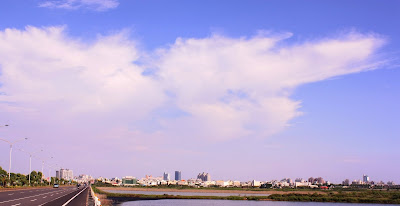
 July 23rd-24th: I'm changing the blog aesthetics. The new blogger head picture was taken today north of Tainan City on route 17, but I may change it again if and when I contrive to take something better. What I had in mind was trying to capture the entire skyline of Tainan City, which would have meant a panorama shot, but there were two problems: first, there was far too much cloud noise (as you can see) and second, though it can't be seen in the new blog header, the view of the tower next to the train station is partially obscured from route 17 by the trees and green construction fencing which has recently been erected along the section just after the main northbound bridge. Zooming in would have meant loss of whatever blue sky I could get and would also have complicated any panorama composite. What I really needed to take a great shot there was a point of elevation. In the end I went with a compromise that took in enough blue sky and enough of the buildings (though not the train station tower) and road to make sense. I'll think about the problem some more later...
 While I was out there I saw the immediate aftermath of a horrible traffic accident. I didn't see the accident itself, but as you can see, that truck has literally crushed the little scooter underneath. I was careful not to include the license plate of the truck in that picture since I have no idea who was at fault. The victim was an 18-20 year old boy - he was still alive, but seemingly only just; he was in such a bloodied and broken up shape that I'd be amazed if he survives. Still, horrors like this are an everyday occurance in Taiwan because driving culture here is permeated with bad epistemology. Essentially, the basic problem is that people don't look around them and think about the omnilateral implications of their vehicle's movement relative to the position of other drivers (hence my blog address). Since the moment I first arrived in Taiwan I've always promised myself that nothing like that would ever happen to me, and though I've been in a few minor scrapes, it never has.
  Anyway, it was lovely weather so off I went to continue taking pictures before getting myself lost in an unfamiliar district of the town and then getting back to the park. On the right is a picture of the Anping river, which though nothing special in itself, does show the tri-colour set I most associate with Taiwan (south Taiwan anyway): blue, white and green. The problem with the new blog header is just that: too much white, and not enough blue and not enough green.
From all of today's reading, I thought Mark Steyn had the best words:
"...the “debt ceiling” debate is regarded by most Democrats and a fair few Republicans as some sort of ghastly social faux pas by boorish conservatives: Why, everyone knows ye olde debt-limit vote is merely a bit of traditional ceremonial, like the Lord Chancellor walking backwards with the Cap of Maintenance and Black Rod shouting “Hats off, strangers!” at Britain’s Opening of Parliament. You hit the debt ceiling, you jack it up a couple trillion, and life goes on — or so it did until these GOP yahoos came along and decided to treat the vote as if it actually meant something."Read the whole thing!
Saturday, 23 July 2011
Seen Through A Better Light...
Yesterday afternoon (thursday) and today (friday) were the first moments of sunshine we've had in Tainan for about a fortnight. Yesterday's light in the west was quite good around 6pm, so I took a couple of snaps (sans filters) from my newly immaculated balcony before heading off out...


I am very pleased to be able to say that I will no longer be moving house. I love this view out west toward downtown Tainan City on the horizon, and particularly the little differently coloured patchwork of rooftops immediately below. There are many other things about this place that I love too, and which, in the time I've spent here render it in greater affection than the comparatively far more luxurious place I used to have in Kaohsiung.
This morning I went for a medical, which meant that I got to spend the later part of the morning in the park afterwards. It was refreshing to be able to climb up into the tree again: today's reading was a small bit of history...


... from an essay by the late Larry Sechrest on "Privateering and National Defense: Naval Warfare for Private Profit" which is chapter 7 in the collection "The Myth Of National Defense: Essays On The Theory And History Of Security Production" edited by Hans Hermann Hoppe (p271-272). I grabbed the pdf version through the Mises Institute and had it printed out. There are onlynine (eleven - ed) essays in there, so I'll probably have it finished tommorow unless I decide to go for a drive or a swim.
I'm on the lookout for a new spot to photograph to replace my blogger heading picture which has been grating on me for some time now. I know more or less what colours I'm looking for and what sort of light. We'll see...


I am very pleased to be able to say that I will no longer be moving house. I love this view out west toward downtown Tainan City on the horizon, and particularly the little differently coloured patchwork of rooftops immediately below. There are many other things about this place that I love too, and which, in the time I've spent here render it in greater affection than the comparatively far more luxurious place I used to have in Kaohsiung.
This morning I went for a medical, which meant that I got to spend the later part of the morning in the park afterwards. It was refreshing to be able to climb up into the tree again: today's reading was a small bit of history...


... from an essay by the late Larry Sechrest on "Privateering and National Defense: Naval Warfare for Private Profit" which is chapter 7 in the collection "The Myth Of National Defense: Essays On The Theory And History Of Security Production" edited by Hans Hermann Hoppe (p271-272). I grabbed the pdf version through the Mises Institute and had it printed out. There are only
I'm on the lookout for a new spot to photograph to replace my blogger heading picture which has been grating on me for some time now. I know more or less what colours I'm looking for and what sort of light. We'll see...
Friday, 22 July 2011
Monetary Reform > Minimum Wage Reform
Sirs,
The recent complaints from trade unionists over the 5% increase to the minimum wage (mentioned in Friday's edition) were as myopic as they were predictable.
The real threat to the livelihoods of working people in Taiwan has been the long term suppression of interest rates which discourages people from the use of savings accounts and pushes them into the stock market and into property.
Because interest rates have not reflected the real time preferences of savers (they are typically below the rate of inflation) for many years now, this means that there is probably a substantial degree of capital overinvestment funded by artificially cheap credit.
Let us hope that this overinvestment is not kindled by economic exposure to the wake of the looming debt defaults in the U.S., Europe and possibly China. For we must also be mindful of the fact that, like the European PIIGS, Taiwan's government must surely be close to its' "debt-saturation point" with the national debt now at approximately 165% of nominal GDP - due largely to massive, annual over-spends in the government's dominance over the education and healthcare markets.
Any sudden increase in inflationary pressure on the NT$ dollar - by, for instance, a policy of debt monetization or "quantitative easing" as it is euphemistically known - could potentially be catastrophic for the working people of Taiwan who do not have substantial investments in metals to protect themselves with.
The looming prospect of currency collapse in the U.S. and Europe must not be ignored in Asian countries like Taiwan. It is vital for the public to be informed about the relative merits of the various "hard money" monetary reforms such as the gold standard, competing commodity currencies, digital currencies and free banking. Such reforms have recently even been discussed in the UK Parliament, yet in Taiwan the problem of monetary reform receives scant attention.
Here is an opportunity for the Taipei Times to report on something far more significant for the welfare of working people in Taiwan than this or that percentage change in the minimum wage.
Yours freely,
Michael Fagan.
(Sent: Friday 22nd July 2011. Unpublished by the Taipei Times).
Note: The initial sending failed for some unknown reason - on resending it, I toned down the final paragraph, and have done the same here.
The recent complaints from trade unionists over the 5% increase to the minimum wage (mentioned in Friday's edition) were as myopic as they were predictable.
The real threat to the livelihoods of working people in Taiwan has been the long term suppression of interest rates which discourages people from the use of savings accounts and pushes them into the stock market and into property.
Because interest rates have not reflected the real time preferences of savers (they are typically below the rate of inflation) for many years now, this means that there is probably a substantial degree of capital overinvestment funded by artificially cheap credit.
Let us hope that this overinvestment is not kindled by economic exposure to the wake of the looming debt defaults in the U.S., Europe and possibly China. For we must also be mindful of the fact that, like the European PIIGS, Taiwan's government must surely be close to its' "debt-saturation point" with the national debt now at approximately 165% of nominal GDP - due largely to massive, annual over-spends in the government's dominance over the education and healthcare markets.
Any sudden increase in inflationary pressure on the NT$ dollar - by, for instance, a policy of debt monetization or "quantitative easing" as it is euphemistically known - could potentially be catastrophic for the working people of Taiwan who do not have substantial investments in metals to protect themselves with.
The looming prospect of currency collapse in the U.S. and Europe must not be ignored in Asian countries like Taiwan. It is vital for the public to be informed about the relative merits of the various "hard money" monetary reforms such as the gold standard, competing commodity currencies, digital currencies and free banking. Such reforms have recently even been discussed in the UK Parliament, yet in Taiwan the problem of monetary reform receives scant attention.
Here is an opportunity for the Taipei Times to report on something far more significant for the welfare of working people in Taiwan than this or that percentage change in the minimum wage.
Yours freely,
Michael Fagan.
(Sent: Friday 22nd July 2011. Unpublished by the Taipei Times).
Note: The initial sending failed for some unknown reason - on resending it, I toned down the final paragraph, and have done the same here.
Thursday, 21 July 2011
Wednesday, 20 July 2011
"Controlled Flight Into Terrain"
"The moderate free-market crowd is still under the illusion that an apolitical, independent central bank could be possible that would simply provide... stable fiat money for the market economy. How naïve!"Detlev Schlichter remarks on the stupidity of the moderates on the Right (never mind the entire Left). Meanwhile in the Telegraph, the unimpeachable Ambrose Evans-Pritchard reports a remark made by the chairman of a very large mining company:
"One of the big US banks texted me today to say that if QE3 actually happens, we could see gold at $5,000 and silver at $1,000."I think it may be too late for reform from within if QE3 gets the go-ahead - of course attempts at floating new currencies will happen - but they will likely be framed in the myopic, Statist terms Schlichter disparages above. The wake is going to be very rough and yet the whole collapse could have been averted if enough people in positions of influence had heeded the warnings issued by the stars of the libertarian movement over the last five or six years - or indeed even by mere earthlings such as myself as recently as February 2009.
Tuesday, 19 July 2011
Against J.Michael Cole's "Pessimism" Editorial
"In addition to helping us avoid repeating the mistakes of the past, history can also teach us that our pessimistic urges, when we believe that all is lost, have nothing original about them."Originality, or the lack thereof, is no refutation to facts whose implications are most naturally rendered in "pessimistic" colours (for example, it is a fact that current levels of U.S. government spending are "unsustainable"). That being said however, I do not think the PRC will outlive the current decade - though I cannot say that doubt is an entirely optimistic one (imagine the internal pressures on a democractic Chinese government to launch itself into another nationalist war).
"There was a time, soon after the euphoria that followed the end of World War II, when failure seemed certain and that the selflessness and sacrifices of the “greatest generation,” which had ensured victory of the “free world” against fascism, had been spent in vain."In vain for whom? Many Chinese and Eastern Europeans may have once had "interesting" opinions about that.
"Sixty years later, the West finds itself in a similar situation. Just as it did back then, pessimism pervades in the wake of a sweeping ideological victory."Pessimism among whom and with regard to what ideals? I do not think, for example, that the current political leadership of the important Western countries (i.e. the U.S.) is "pessimistic". I think they are perverted by their own democratically-necessitated pragmatism. It is through this which a nihilistic impulse is gradually corroding the political and cultural instantiation of Liberal principles such as private property and freedom of thought and speech.
"There is no reason why democracies should capitulate on human rights just because China’s economy is supposedly holding the whole world together..."To the extent that the populations of these democracies are infected with anti-conceptual and value-levelling mental reflexes (e.g. the ironic drive against "discrimination" even as more and more aspects of life fall under the political axe of illegality), then there is every reason for the political leadership to capitulate: reflecting this is their arc to power.
"The “China threat” looms large because through pessimism, the West has allowed Beijing — a Beijing that is endlessly wracked by insecurity, ironically — to get away with murder for too long."It is not through pessimism, it is through a political pragmatism coupled to a creeping mental nihilism that the West is allowing Beijing to get away with murder.
Monday, 18 July 2011
Call To The Community Organizer-In-Chief
"I let my Mexican drug lord license expire. Am I still eligible for the free machine gun program?"Iowahawk rubbishes President Obama on Twitter. Funny 'cos it's true!
Sunday, 17 July 2011
When To Drink

For me, a good beer tastes especially righteous after I've worked up a sweat sweeping, mopping, scrubbing and generally tidying up the place (buying or possibly making a proper book case is still something that needs to be done; I rediscovered books which I'd forgotten I had). Today I did more than the usual in that I sorted out all the old plant pots, iron pot hangers and white display steps in which I used to keep my mint, basil, lettuce and tomato plants before I got my dog. Now that she isn't a daft little puppy anymore, I might start the mint and basil again, but the tomato plants are out of the question.
North Vs South
The contemptibly base in-group, out-group slanging dynamic which was behind the setting up of the new Taiwan Nationalist Party can also be seen through this story about a TV show ridiculing southern Taiwanese women.
Yet this isn't in essence about women and their frivolities; it's about the north-vs-south political and cultural divide. Rather than responding by smothering this divide with an over-bearing Taiwanese nationalism, it would be better to dishonour the entire discourse with an aloof dismissal.
I'll always be on the southside of the island.
"The episode, aired on Wednesday, invited women from southern Taiwan to discuss the differences between women in northern and southern Taiwan. During the show, clothing, makeup, accent and bearing were compared, all at the expense of women from southern Taiwan."As Ben Goren remarks, this sort of thing is in the same vein as...
"The case of diplomat Kuo Kuang-ying... especially his comment about southerners being red-neck Japanese pirates."Har har, me bonnie lad!
Yet this isn't in essence about women and their frivolities; it's about the north-vs-south political and cultural divide. Rather than responding by smothering this divide with an over-bearing Taiwanese nationalism, it would be better to dishonour the entire discourse with an aloof dismissal.
I'll always be on the southside of the island.
Response To Editorial On Coming "Budget Crisis"
Sunday's unsigned editorial in the Taipei Times takes a look at the government's budget cuts for next year's public works projects in Taiwan:
The Keynesian proposition that government spending per se somehow "contributes" to the economy is a fallacy on several counts. First, government spending can only "contribute" to the economy if the money is first forcibly extracted from the people who make up that economy - whether by current or future taxation. Since there is no sure way to know how that money would otherwise have been spent had it remained in private hands rather than stolen by the government, any empirical comparison of the distributed consequences is obviously mute. It is the classic example of Bastiat's "broken window" fallacy, or of costs that are "unseen". Second, the efficiency of government spending tends to be derailed to a considerable extent by the attentions of rent-seeking groups - particularly in a democracy. In Taiwan for example, the construction and maintenance of roads tends to be particularly poor not due to a lack of technical knowledge or lack of resources, but because existing regulations governing the material composition and procedural construction of roads tends to benefit particular suppliers and contractors.
A "fundamental" solution would be to stop feeding the growth of government.
"The announcement by the Council for Economic Planning and Development on Monday that it approved a NT$216.6 billion (US$7.5 billion) budget for major public construction projects next year is an issue that deserves far more attention than it has so far received.There seem to be two fallacies intertwined here: the first is the implicit premise that public goods can only be, or ought to be, provided by government whilst the second seems to be the Keynesian proposition that government spending per se is somehow a "contribution" to the economy. Here they are expressed perhaps a little more clearly:
That number represents the lowest level in 10 years — and therefore a lower public spending contribution to the nation’s economy."
"The importance of investing in infrastructure is self-evident: It creates jobs and drives up domestic investment in the short term, while developing opportunities for economic growth in the long term."On the public goods problem, there are several reasons to reject the proposition that it can only be solved by government. First, there is the non-aggression principle: government provision of a public good also necessitates a "public bad", i.e. the forcible extraction of value via taxation and the wider market consequences this must necessarily have. Everybody will make his or her own judgement as to whether the public good cancels out the public bad, but nobody should be under any delusion that there is anything like free choice in the matter. Second, there are numerous cases across several industries of private production of public goods occuring due to producers figuring out ways to restructure the incentives available to them (e.g. the use of advertising in radio). Third, when governments spend money to provide public goods they may thereby deincentivize private production of the good in the economic sense (i.e. a private producer would not then be able to profit from finding a solution to producing it, e.g. toll-roads) and perhaps also in the legal sense (i.e. the government may legally prohibit private production of this public good, e.g. juridicial and policing services).
The Keynesian proposition that government spending per se somehow "contributes" to the economy is a fallacy on several counts. First, government spending can only "contribute" to the economy if the money is first forcibly extracted from the people who make up that economy - whether by current or future taxation. Since there is no sure way to know how that money would otherwise have been spent had it remained in private hands rather than stolen by the government, any empirical comparison of the distributed consequences is obviously mute. It is the classic example of Bastiat's "broken window" fallacy, or of costs that are "unseen". Second, the efficiency of government spending tends to be derailed to a considerable extent by the attentions of rent-seeking groups - particularly in a democracy. In Taiwan for example, the construction and maintenance of roads tends to be particularly poor not due to a lack of technical knowledge or lack of resources, but because existing regulations governing the material composition and procedural construction of roads tends to benefit particular suppliers and contractors.
"If the budget cut were to reflect an effort to implement conservative and prudent policies while maintaining fiscal discipline, then that would constitute a step in right direction, but the government needs to proceed cautiously.It might well be the case that the cash is being redirected to fund lavish benefits for civil servants, which, we must remember, are themselves a rent-seeking group whom the governing administration must reward in order either to maintain (KMT) or curry (DPP) favour with them at the ballot box. Yet raising taxes on the wealthy is a stupidity on several counts: in the first place it is simply another repetition of the State's predatory reflex; it will likely obviate the need for even further spending cuts and a greater impetus toward the liberalization of certain markets from State control (e.g. education and healthcare); it will do nothing to reduce the rent-seeking power and well known political bias of the beurobots in the civil service; and finally, being exposed to a government intent on tax hikes may act as a general disincentive to all manner of prospective private investments.
However, if the true reason for such a big cut in the public works budget is that the government needs to fund its pay hike for civil servants amid rising public debt and declining tax revenues, the obvious answer would be to cancel the pay raise for civil servants and increase taxes on the wealthy."
"The government could take different approaches to fill the funding gap... but a fundamental solution to the problem ultimately depends on the much needed reforms of the nation’s distorted tax and fiscal system — which needs real action now, not cosmetic change designed to cover up political imperatives."Advocating tax increases on the wealthy does not amount to a "fundamental solution"; rather, it would amount only to a retraining of the reach and grasp of the State's predatory reflex - a retraining that will simply perpetuate the problem of what conservatives call "fiscal irresponsibility".
A "fundamental" solution would be to stop feeding the growth of government.
Saturday, 16 July 2011
On Ted Lau's Letter
Sirs,
Common as it is to hear the words "ideology", "ideological" and "idealogue" uttered with the derogatory, connotating aspect of "dogma", it would be a serious mistake to slip into this practice as an habitual reflex.
For it is not only the case that, in the realm of politics, "ideas have consequences", but that there is certain logic to the consequences of these ideas. Once legislative discussion of the merits of this or that State policy ceases to be informed by ideological aims, and instead focuses exclusively upon pragmatist calculations, then the door is opened to a more vigorous and primitive form of decision making.
Today's published letter by Ted Lau of the newly formed "Taiwan Nationalist Party" offers ample demonstration of this point, despite his corrections to Mr Cole's earlier editorial piece. For although Mr Lau does not call for the deportation of what he terms "Chilans" from Taiwan, his argument for expulsion of said people from political office does not aspire to the nobility of an ethically shaped ideology but rather, it is a degenerate pragmatism anchored only to the vague, though explicitly nationalist sense of those people who "continue to identify themselves as Chinese". Either this sense of identification he refers to is cultural - in which case it can be specified as a set of ideas and thus subject to rational criticism - or it can be reduced to mere ethnicity. It seems likely that this latter alternative is what Lau had in mind given his references to President Ma and Ma's talk of having "the blood of the Yellow Emperor" running within his veins.
It is imperative that we realize what seems to be happening: the rationality of political discourse in Taiwan has been reduced from talk of liberalization and democratization during the 1980s and 1990s to the arbitrariness and intellectual corruption of ethnically defined in-groups and out-groups.
I submit that this is consequent to the abandonment of even a pretense of Liberal, pro-free market ideology in favour of debased, pragmatist calculations of how to distribute State favours and corporate and social welfare to this or that group of rent seekers.
Such a State is rotten from the inside out and cannot last - to the extent this continues, the dreams of international recognition and respect for an independent Taiwan can only be rendered vain and contemptible.
Yours freely,
Michael Fagan.
(Sent: Saturday 16th July 2011. Unpublished by the Taipei Times.)
Common as it is to hear the words "ideology", "ideological" and "idealogue" uttered with the derogatory, connotating aspect of "dogma", it would be a serious mistake to slip into this practice as an habitual reflex.
For it is not only the case that, in the realm of politics, "ideas have consequences", but that there is certain logic to the consequences of these ideas. Once legislative discussion of the merits of this or that State policy ceases to be informed by ideological aims, and instead focuses exclusively upon pragmatist calculations, then the door is opened to a more vigorous and primitive form of decision making.
Today's published letter by Ted Lau of the newly formed "Taiwan Nationalist Party" offers ample demonstration of this point, despite his corrections to Mr Cole's earlier editorial piece. For although Mr Lau does not call for the deportation of what he terms "Chilans" from Taiwan, his argument for expulsion of said people from political office does not aspire to the nobility of an ethically shaped ideology but rather, it is a degenerate pragmatism anchored only to the vague, though explicitly nationalist sense of those people who "continue to identify themselves as Chinese". Either this sense of identification he refers to is cultural - in which case it can be specified as a set of ideas and thus subject to rational criticism - or it can be reduced to mere ethnicity. It seems likely that this latter alternative is what Lau had in mind given his references to President Ma and Ma's talk of having "the blood of the Yellow Emperor" running within his veins.
It is imperative that we realize what seems to be happening: the rationality of political discourse in Taiwan has been reduced from talk of liberalization and democratization during the 1980s and 1990s to the arbitrariness and intellectual corruption of ethnically defined in-groups and out-groups.
I submit that this is consequent to the abandonment of even a pretense of Liberal, pro-free market ideology in favour of debased, pragmatist calculations of how to distribute State favours and corporate and social welfare to this or that group of rent seekers.
Such a State is rotten from the inside out and cannot last - to the extent this continues, the dreams of international recognition and respect for an independent Taiwan can only be rendered vain and contemptible.
Yours freely,
Michael Fagan.
(Sent: Saturday 16th July 2011. Unpublished by the Taipei Times.)
Letter On President Ma's "Taiwanese-ness"
Sirs,
Are not the most powerful words in all languages the smallest ones?
"So..."
That was the word into which each of my various streams of questioness quite naturally coalesced on learning of President Ma's recent claim that he "fights" for "Taiwan" and that he is "Taiwanese".
So... against whom does President Ma "fight"? The despotic government in Beijing certainly doesn't seem to have noticed if they are indeed the ones against whom President Ma fights. Yet perhaps the President had more powerful foes in mind - for example, could he have meant Chu Feng Min, an elderly farmer from Miaoli County who, on August 3rd last year swallowed a bottle of insecticide on learning that her land would be legally stolen (I will forever refuse that apologetic and dispicable lie-word "expropriation")? If so, then perhaps the President's use of the present tense was accurate as yet more farmers in Hsinchu face the prospect of further violation of their property rights.
So... what does President Ma refer to when he uses the word "Taiwan" in the same breath as enunciating his position as President of the R.O.C? Does his "Taiwan" include the shores of Shanyuan Bay (杉原灣) in Taitung County on which a hotel developer, assisted by the predatory powers of the local government, has forcibly taken land over which the local Aborigines had historical claims? If not, then perhaps that is because the "Taiwan" President Ma "fights" for is not a geographical entity occupied by mere people, but a far grander nationalist abstraction over which only "Taiwanese" members have any rightful claims. Perhaps it is safe to assume that Aborigine people need not bother to apply for President Ma's help - at least not without a reservation, and preferably one well out of the way of potential tourist spots.
So... if even the native people of Taiwan cannot be considered "Taiwanese" then what hope can the people descended from recent Chinese immigrants possibly invest in President Ma "fighting" for them? Since they are mixed with the majority of the population, a naive observer might at least suppose that President Ma would attempt to bestow upon them a system of government that protected their individual rights and interests equally (even if some farmers and Aborigines occassionally get chewed up and left behind). Yet the President is presiding over a transparently partisan judiciary which cannot be trusted and a near-bankrupt set of State finances in which national debt is estimated by the IMF (NT$21 trillion) to be approximately 160% of annual, nominal GDP (NT$12.5 trillion) - leaving a per capita debt of almost NT$1,000,000! A huge some of debt for every "Taiwanese" child of today and tommorow? Could not the President at least attempt to solve this problem by giving back the control of education and healthcare to the private hands of his lionized "Taiwanese" people?
Sirs, in view of the provocative power of small words, I would urge President Ma to say "No" to further predatory violations of private property rights; to say "No" to the predatory dismissal of the Aborigine people's property rights claims; to say "No" to the continuing politicization of the judiciary and legal system; and to say "No" to further government spending and debt accumulation.
But I do not think President Ma would listen to a non-Taiwanese such as myself; I do not have the blood of the "Yellow Emperor" in my veins.
Yours freely,
Michael Fagan.
(Sent: Saturday, 16th July 2011. Unpublished by the Taipei Times.)
Are not the most powerful words in all languages the smallest ones?
"So..."
That was the word into which each of my various streams of questioness quite naturally coalesced on learning of President Ma's recent claim that he "fights" for "Taiwan" and that he is "Taiwanese".
So... against whom does President Ma "fight"? The despotic government in Beijing certainly doesn't seem to have noticed if they are indeed the ones against whom President Ma fights. Yet perhaps the President had more powerful foes in mind - for example, could he have meant Chu Feng Min, an elderly farmer from Miaoli County who, on August 3rd last year swallowed a bottle of insecticide on learning that her land would be legally stolen (I will forever refuse that apologetic and dispicable lie-word "expropriation")? If so, then perhaps the President's use of the present tense was accurate as yet more farmers in Hsinchu face the prospect of further violation of their property rights.
So... what does President Ma refer to when he uses the word "Taiwan" in the same breath as enunciating his position as President of the R.O.C? Does his "Taiwan" include the shores of Shanyuan Bay (杉原灣) in Taitung County on which a hotel developer, assisted by the predatory powers of the local government, has forcibly taken land over which the local Aborigines had historical claims? If not, then perhaps that is because the "Taiwan" President Ma "fights" for is not a geographical entity occupied by mere people, but a far grander nationalist abstraction over which only "Taiwanese" members have any rightful claims. Perhaps it is safe to assume that Aborigine people need not bother to apply for President Ma's help - at least not without a reservation, and preferably one well out of the way of potential tourist spots.
So... if even the native people of Taiwan cannot be considered "Taiwanese" then what hope can the people descended from recent Chinese immigrants possibly invest in President Ma "fighting" for them? Since they are mixed with the majority of the population, a naive observer might at least suppose that President Ma would attempt to bestow upon them a system of government that protected their individual rights and interests equally (even if some farmers and Aborigines occassionally get chewed up and left behind). Yet the President is presiding over a transparently partisan judiciary which cannot be trusted and a near-bankrupt set of State finances in which national debt is estimated by the IMF (NT$21 trillion) to be approximately 160% of annual, nominal GDP (NT$12.5 trillion) - leaving a per capita debt of almost NT$1,000,000! A huge some of debt for every "Taiwanese" child of today and tommorow? Could not the President at least attempt to solve this problem by giving back the control of education and healthcare to the private hands of his lionized "Taiwanese" people?
Sirs, in view of the provocative power of small words, I would urge President Ma to say "No" to further predatory violations of private property rights; to say "No" to the predatory dismissal of the Aborigine people's property rights claims; to say "No" to the continuing politicization of the judiciary and legal system; and to say "No" to further government spending and debt accumulation.
But I do not think President Ma would listen to a non-Taiwanese such as myself; I do not have the blood of the "Yellow Emperor" in my veins.
Yours freely,
Michael Fagan.
(Sent: Saturday, 16th July 2011. Unpublished by the Taipei Times.)
Friday, 15 July 2011

Wednesday, 13 July 2011
Why You Wait So Long?


I'm obsessed with the mountainous area out at the north end of Kaohsiung County (Taoyuan District) as it reaches up to Nantou and across to Hualien and Taitung. I keep wanting to be out there with all the time in the world. I miss it. I was out there this time last week. Today I have other things keeping me, which I resent. I keep wanting to get out there. There is a perceptual thrill to driving through the mountains which inheres in the parallel and orthogonal movement of shapes, surfaces and colours relative to the body's own position and which cannot be captured in still photography. If you have a good copy of the "Thin White Duke" remix of Mirwais' remix of the Stones' "Miss You" (that youtubed version is low quality), then listen to that: it expresses that mad sense of frustrated enthusiasm and irritability I have about wanting to drive through the mountains but not being able to (except the song is about a girl).
Tuesday, 12 July 2011
A Free Labour Market Is Not A "Resource"
Today the Taipei Times carried an imported editorial (written by two Oxford dons: Ian Goldin and Geoffrey Cameron) advocating the dismantling of restrictions on migration. Some of it is such obvious good sense as to be incrongruous with its appearance in the Taipei Times, which as the socialists employed there will agree, is usually a bastion of bullshit. However, as soon as I had read the subheading, I knew it would be shot through with the Pragmatist flaw. Here is the second paragraph to the opening:
Of course I am aware that immigration is tied up with other problems. In the U.S. for example, Mexican immigration is tied up with the dangers posed by the drug cartel conflicts spilling over across the border. Even were the U.S. government to end its stupid "war on drugs", the ending of its closed border policy would only be replaced with private efforts to that effect whose major worry, in addition to the drug cartels, would be the predations of the ATF trying to set them up as a pretense for the further criminalization of firearms - as in Project Gunwalker*. Dismantling restrictions to migration therefore, cannot be accomplised in isolation from the complementary dismantling of other aspects of State interference with society. The authors of this piece, however, do not seem to agree...
Outrageous.
You should be reading this Goldin.
That is f*cking outrageous.
It is outrageous because the authors thereby invoke the principle of slavery applied to a degree arbitrarily considered small enough so as not to count as "real slavery" to all "normal" people infected with the Pragmatist inability to trace consequential effects back to principles of human action.
What this article reminds me of is something which has been creeping me out for a long time. When I was in my mid-teens I held various part-time jobs at supermarkets and wholesale stores (a bit like Costco) while I was getting ready to make the mistake of going to University. I remember that, in each of the places I worked at during that time there was always something called a "Personnel Department" - a name which instantly made perfect sense to me as a reflection of its function in dealing with employee matters, since the term "personnel" is a derivation of "person", which is what all employees are. At some point some years later, that changed. I don't know when exactly it changed, but the name of this function of companies changed to "Human Resources".
Reflect on that word... "resources".
That name change creeps me out because it appears to signify the reduction of people to mere objects to be ingested by a productive system misapprehended with Dickensian machine-metaphors propagated by nearly all wings of the Left. I regard this name change as one of the high-exposure points of the cultural pervasiveness of the Left's bullshit. A whole generation of kids has now been raised with no awareness that people just like them were once explicitly regarded by employers as people rather than mere "human resources". The corruption of the language consequent to the philosophical suppression of Liberal ethics (and the metaphysics underlying it) is a large part of why people - adults even, much less kids - cannot always be expected to think and recognize the Left's evil gibberish about financing "healthcare and pensions" when they see it.
A free labour market is politically good in all aspects, but it is not a goddamn "resource".
* I note as an addendum here, that Turton's response to Okami's mention of the ATF Gunwalker scandal here is exaggerated to the brownth degree: the Daily Kos had the story, true, but even they admitted the "notable lack of attention paid to this scandal by progressives and the left-wing blogosphere". The reason for this of course is that most of the Left cannot bring themselves to admit that freedom includes the freedom to own the most effective means of self-defense.
"A higher rate of global migration is desirable for four reasons: It is a source of innovation and dynamism; it responds to labor shortages; it meets the challenges posed by rapidly aging populations and it provides an escape from poverty and persecution. By contrast, limiting migration slows economic growth and undermines societies’ long-term competitiveness. It also creates a less prosperous, more unequal and partitioned world."No. The most important reason why immigration controls ought to be dismantled is because freedom is a natural born right of people everywhere. Those other listed reasons are merely consequences, which though very good, cannot constitute the ethical pivot of a pro-migration position.
Of course I am aware that immigration is tied up with other problems. In the U.S. for example, Mexican immigration is tied up with the dangers posed by the drug cartel conflicts spilling over across the border. Even were the U.S. government to end its stupid "war on drugs", the ending of its closed border policy would only be replaced with private efforts to that effect whose major worry, in addition to the drug cartels, would be the predations of the ATF trying to set them up as a pretense for the further criminalization of firearms - as in Project Gunwalker*. Dismantling restrictions to migration therefore, cannot be accomplised in isolation from the complementary dismantling of other aspects of State interference with society. The authors of this piece, however, do not seem to agree...
"As countries’ populations age and their fertility rates collapse, more migration will be necessary to ensure economic competitiveness and finance pension and health-care systems."That's the Pragmatist streak running through the entire article at its' point of greatest exposure. The implicit premise here is of the cattle farmer: new immigrants are good because their surplus productive value can be farmed in order to sustain the State run pension and healthcare systems.
Outrageous.
You should be reading this Goldin.
That is f*cking outrageous.
It is outrageous because the authors thereby invoke the principle of slavery applied to a degree arbitrarily considered small enough so as not to count as "real slavery" to all "normal" people infected with the Pragmatist inability to trace consequential effects back to principles of human action.
What this article reminds me of is something which has been creeping me out for a long time. When I was in my mid-teens I held various part-time jobs at supermarkets and wholesale stores (a bit like Costco) while I was getting ready to make the mistake of going to University. I remember that, in each of the places I worked at during that time there was always something called a "Personnel Department" - a name which instantly made perfect sense to me as a reflection of its function in dealing with employee matters, since the term "personnel" is a derivation of "person", which is what all employees are. At some point some years later, that changed. I don't know when exactly it changed, but the name of this function of companies changed to "Human Resources".
Reflect on that word... "resources".
That name change creeps me out because it appears to signify the reduction of people to mere objects to be ingested by a productive system misapprehended with Dickensian machine-metaphors propagated by nearly all wings of the Left. I regard this name change as one of the high-exposure points of the cultural pervasiveness of the Left's bullshit. A whole generation of kids has now been raised with no awareness that people just like them were once explicitly regarded by employers as people rather than mere "human resources". The corruption of the language consequent to the philosophical suppression of Liberal ethics (and the metaphysics underlying it) is a large part of why people - adults even, much less kids - cannot always be expected to think and recognize the Left's evil gibberish about financing "healthcare and pensions" when they see it.
A free labour market is politically good in all aspects, but it is not a goddamn "resource".
* I note as an addendum here, that Turton's response to Okami's mention of the ATF Gunwalker scandal here is exaggerated to the brownth degree: the Daily Kos had the story, true, but even they admitted the "notable lack of attention paid to this scandal by progressives and the left-wing blogosphere". The reason for this of course is that most of the Left cannot bring themselves to admit that freedom includes the freedom to own the most effective means of self-defense.
Monday, 11 July 2011
Puppies (Re-abandoned)

 The seven puppies which were abandoned in the park nearly two months ago were adopted by various local Taiwanese people. Or so I thought until about a week ago - four of them have since been re-abandoned in the park and naturally the costs of looking after them every day have fallen on me* - in addition to the three strays (Picky, Black & White and Meimei) and my own dog. They've grown a lot in the last two months, and of course they get plenty of chicken and biscuit and milk from me. I'd rather they stay in the park than adopt them, but I have to worry about the problems with this (locals, traffic, other dogs, disease etc). If I do adopt one or all of them, I'll need to think about how my dog will react to them and then deal with the guilt of not having adopted the adult dogs (I can't accept any rationalization of this in terms of their not being so easy to train).
There are other considerations too. Damn it.
* The costs have fallen mostly on me, although I do get some help from some of the locals occassionally and my friend Wang.
Baoli (寶來), Kaohsiung County (高雄縣)

NB: I've removed my post on the John Copper article and Van Dam's letter; I got a bit carried away with that.
Sunday, 10 July 2011
On Unemployment...
I would like to be able to write that today's editorial in the Taipei Times "addressed" the matter of unemployment. However, I cannot - for the fact is whoever wrote that editorial article got the "address" wrong. The problem of unemployment does not reside in the collectivist premise of the nation-state, though of course it is to be expected that the journalists of the Taipei Times and the Liberty Times are conditioned to look upon everything from that standpoint given the overarching political problem of Taiwan-China relations and the international standing, or lack thereof, of the State of the Republic of China.
I would imagine that the opening sentence of that editorial will most likely be read at skimming pace by typical readers such that its conceptual error goes unnoticed:
"...the loss of Taiwanese jobs to China..."
The possessive inflection ("Taiwanese"), when taken in conjunction with the verb phrase within which it occurs ("loss of"), indicates the notion that jobs somehow rightfully belong to the Taiwanese people and that the transfer of these jobs to China is either unfortunate or somehow wrong. This notion is both false and dangerous.
A "job" is a function that one party voluntarily agrees to perform for another party in exchange for monetary recompense. If I pay a worker to perform the function of operating an industrial lathe for me, then he has a job. He acquired that job because I offered it to him, and I was able to do so because I have property rights in the company, factory and machinery, including the lathe. I own the job which the worker is performing because I own the capital equipment necessary to its existence. Since I own the job, I am free to hire whichever worker I might prefer to perform it on my behalf. To describe a "job" with the possessive inflection of "Taiwanese" contradicts this arrangement and implies that the job actually belongs to the broader Taiwanese society - in which case my property rights are fictious and become mere priveleges granted by the R.O.C state (despite its own constitution).
What else could the phrase "...the loss of Taiwanese jobs to China..." mean?
If it was simply meant that the jobs were geographically located in Taiwan prior to their "loss" to China, then why wasn't this expressed as "... the transfer of jobs from Taiwan to China..."? I believe it is because that wasn't the intended meaning at all. I think the writer genuinely believes that jobs somehow belong to the wider Taiwanese society.
In the space of a mere seven-word phrase in his opening sentence then, it would seem that the writer of that editorial has confessed to an embrace of nationalist/socialist* principles of economic organization and a rejection of liberal, capitalist principles. Such a person might attempt to defend Taiwanese democracy without contradiction, but should he or she claim to defend "freedom" or "liberalism" (or to be a "liberal" in the debased, U.S. misuse of the term), then this claim would be false. Such a person does not fight for the freedom of Taiwanese people, but rather, for their own enslavement to the commands of the government in Taipei rather than the one in Beijing.
However, the editorial is interesting for other reasons...
My guess would be that unemployment, though falling somewhat, remains relatively high for a number of reasons one of which, as the article points out, is the relocation of "labour intensive" industries to China. However, this can only be one aspect of what is happening since the government in Taipei still imposes restrictions on the nature and extent of industrial and business investments in China. Moreover, the unemployment left behind by capital flight to China should in theory reduce the marginal costs of labour in Taiwan to other kinds of businesses who could then, over time, begin to re-employ these workers in other areas. Perhaps this is happening to some degree now, but there are certainly other things occuring in addition to this - both seen and unseeen - the effect of which is to buoy unemployment.
To begin with, labour costs are driven artificially high by things like minimum wage laws and other long-standing interventions (e.g. immigration controls, licensing rackets and the popularity of State-funded higher "education", all of which restrict the supply of labour). Labour market "rigidity" and "sticky wages" are thus likely to make it difficult for some businesses to offer opportunities for re-employment. This may be exacerbated by other government interventions (e.g. planning laws) which tend to have the effect of increasing the costs and risks of new start-ups. In this circumstance, many people may try to apply for more government jobs and it will always be tempting for a government to expand its powers by instantiating new agencies that require labour (e.g. the TSA in the U.S. along with the broader program of militarization of State and even local police forces).
Additionally, unemployment may be affected by the long-standing availability of cheap finance through the expansion of the money supply (rather than from actual savings), which provides a strong incentive for over-investment** in the production of capital goods. This is because of the temporal nature of production. The profits earned by businesses selling consumer goods directly tend to be far more sensitive to short term changes in consumer demand than those businesses engaged in producing capital goods to be used in the production of consumer goods some years in the future. Businesses of the latter sort (i.e. capital goods businesses) will thus have superior profit margins to those lower down in the production chain; investments in the "high end" of the production chain therefore usually stand to offer far better ROIs than investments in the "low end" of the production chain (i.e. consumer goods businesses). Low interest rates mean that financing such investments becomes sufficiently cheap as to offset their higher investment costs, thus leading to over-investment. The effect this has (or perhaps more accurately, will have) on unemployment levels is perverse, for initially it will tend to reduce unemployment (since demand for labour in the production of capital goods increases) but since it is financed essentially by credit created ex nihilio rather than savings, this effect is illusory.
Because the influx of cheap financing via low interest rates will circulate throughout the economy after its initial use, it will increase inflationary pressures and raise the prices of consumer goods and commodities. The longer this goes on for, the more dangerous it becomes. Should the continuing increase in prices of consumer goods and commodities eventually outpace the rate at which production costs rise, then the apex of the "boom" will have been reached. The change in this ratio will have two chief consequences: first it will mean that the costs of firms producing high-end capital goods will begin to rise more rapidly than their income, resulting in sudden losses; second, it will mean a fall in real wages and thus reincentivize investment in the more "labour-intensive", lower stages of the production chain (the "Ricardo-effect"). Once this contrast in profit margins between the higher and lower stages of the production chain has finally been reversed from what it was initially, then that is the point at which a major landslide of corrective measures is triggered, rippling all the way back down the production chain - measures which will inevitably include forced redundancies in the more "capital-intensive" industries.
That could be the point at which the next "financial crisis" hits and the economy re-enters a period of recession in which unemployment is likely to be much higher than it currently is. Of course, none of the above takes into account the effects of Taiwanese businesses and Taiwanese banks' exposure to the risks of distorted production chains in "other economies" such as China, Europe and the U.S.*** or the sovereign debt crises developing in those countries (including Taiwan itself) - all of which may do more than simply exacerbate the process outlined above, but perhaps even trigger monetary and economic (and thus possibly also political) collapse.
Both labour market and capital market distortions are a result of government interference in the form of myopic regulatory "oversight" on the one hand, and aggressive monetary "easing" on the other hand. Government debt and government spending on top of that add further costs and distortions - both seen and unseen.
All of this comes down to a simple matter of ethical premises: either the means of production (including the medium of exchange itself) are privately owned and self-regulated, or they are collectively owned and thereforemanipulated administered by a privileged minority: the stupidly myopic politicians and their corrupt cronies infecting the banking and industrial sectors.
* It amounts to the same thing in this context.
** I use the term "over-investment" to signify investment not derived from actual savings.
*** Pop quiz: what's the difference between "the global economy" and "the Chinese economy", or "the U.S. economy" or "the Taiwanese economy"?
I would imagine that the opening sentence of that editorial will most likely be read at skimming pace by typical readers such that its conceptual error goes unnoticed:
"A Bloomberg article last week about the loss of Taiwanese jobs to China has drawn mixed reactions."See what it is yet?
"...the loss of Taiwanese jobs to China..."
The possessive inflection ("Taiwanese"), when taken in conjunction with the verb phrase within which it occurs ("loss of"), indicates the notion that jobs somehow rightfully belong to the Taiwanese people and that the transfer of these jobs to China is either unfortunate or somehow wrong. This notion is both false and dangerous.
A "job" is a function that one party voluntarily agrees to perform for another party in exchange for monetary recompense. If I pay a worker to perform the function of operating an industrial lathe for me, then he has a job. He acquired that job because I offered it to him, and I was able to do so because I have property rights in the company, factory and machinery, including the lathe. I own the job which the worker is performing because I own the capital equipment necessary to its existence. Since I own the job, I am free to hire whichever worker I might prefer to perform it on my behalf. To describe a "job" with the possessive inflection of "Taiwanese" contradicts this arrangement and implies that the job actually belongs to the broader Taiwanese society - in which case my property rights are fictious and become mere priveleges granted by the R.O.C state (despite its own constitution).
What else could the phrase "...the loss of Taiwanese jobs to China..." mean?
If it was simply meant that the jobs were geographically located in Taiwan prior to their "loss" to China, then why wasn't this expressed as "... the transfer of jobs from Taiwan to China..."? I believe it is because that wasn't the intended meaning at all. I think the writer genuinely believes that jobs somehow belong to the wider Taiwanese society.
In the space of a mere seven-word phrase in his opening sentence then, it would seem that the writer of that editorial has confessed to an embrace of nationalist/socialist* principles of economic organization and a rejection of liberal, capitalist principles. Such a person might attempt to defend Taiwanese democracy without contradiction, but should he or she claim to defend "freedom" or "liberalism" (or to be a "liberal" in the debased, U.S. misuse of the term), then this claim would be false. Such a person does not fight for the freedom of Taiwanese people, but rather, for their own enslavement to the commands of the government in Taipei rather than the one in Beijing.
However, the editorial is interesting for other reasons...
"Others said Taiwan was facing a labor shortage, rather than high unemployment, with the nation’s unemployment rate falling to 4.27 percent in May, its lowest level in 33 months, after peaking at 6.13 percent in August 2009.Leaving aside that repetition of the nationalist/socialist premise ("the nation's unemployment problems"), I think it is correct that comparisons of current unemployment data with data prior to the "financial crisis" offer a better guide to understanding what is going on than comparisons to unemployment data at any arbitrary point during the tenure of the Ma administration. Of course unemployment has not been "solved". However it may also be true that there are labour shortages. This, however, is not a "paradox" as the writer goes on to describe it at the conclusion of the article.
One thing is clear: It is impossible to say that the nation’s unemployment problems have been solved, because the unemployment rate is still higher than pre-financial crisis levels."
My guess would be that unemployment, though falling somewhat, remains relatively high for a number of reasons one of which, as the article points out, is the relocation of "labour intensive" industries to China. However, this can only be one aspect of what is happening since the government in Taipei still imposes restrictions on the nature and extent of industrial and business investments in China. Moreover, the unemployment left behind by capital flight to China should in theory reduce the marginal costs of labour in Taiwan to other kinds of businesses who could then, over time, begin to re-employ these workers in other areas. Perhaps this is happening to some degree now, but there are certainly other things occuring in addition to this - both seen and unseeen - the effect of which is to buoy unemployment.
To begin with, labour costs are driven artificially high by things like minimum wage laws and other long-standing interventions (e.g. immigration controls, licensing rackets and the popularity of State-funded higher "education", all of which restrict the supply of labour). Labour market "rigidity" and "sticky wages" are thus likely to make it difficult for some businesses to offer opportunities for re-employment. This may be exacerbated by other government interventions (e.g. planning laws) which tend to have the effect of increasing the costs and risks of new start-ups. In this circumstance, many people may try to apply for more government jobs and it will always be tempting for a government to expand its powers by instantiating new agencies that require labour (e.g. the TSA in the U.S. along with the broader program of militarization of State and even local police forces).
Additionally, unemployment may be affected by the long-standing availability of cheap finance through the expansion of the money supply (rather than from actual savings), which provides a strong incentive for over-investment** in the production of capital goods. This is because of the temporal nature of production. The profits earned by businesses selling consumer goods directly tend to be far more sensitive to short term changes in consumer demand than those businesses engaged in producing capital goods to be used in the production of consumer goods some years in the future. Businesses of the latter sort (i.e. capital goods businesses) will thus have superior profit margins to those lower down in the production chain; investments in the "high end" of the production chain therefore usually stand to offer far better ROIs than investments in the "low end" of the production chain (i.e. consumer goods businesses). Low interest rates mean that financing such investments becomes sufficiently cheap as to offset their higher investment costs, thus leading to over-investment. The effect this has (or perhaps more accurately, will have) on unemployment levels is perverse, for initially it will tend to reduce unemployment (since demand for labour in the production of capital goods increases) but since it is financed essentially by credit created ex nihilio rather than savings, this effect is illusory.
Because the influx of cheap financing via low interest rates will circulate throughout the economy after its initial use, it will increase inflationary pressures and raise the prices of consumer goods and commodities. The longer this goes on for, the more dangerous it becomes. Should the continuing increase in prices of consumer goods and commodities eventually outpace the rate at which production costs rise, then the apex of the "boom" will have been reached. The change in this ratio will have two chief consequences: first it will mean that the costs of firms producing high-end capital goods will begin to rise more rapidly than their income, resulting in sudden losses; second, it will mean a fall in real wages and thus reincentivize investment in the more "labour-intensive", lower stages of the production chain (the "Ricardo-effect"). Once this contrast in profit margins between the higher and lower stages of the production chain has finally been reversed from what it was initially, then that is the point at which a major landslide of corrective measures is triggered, rippling all the way back down the production chain - measures which will inevitably include forced redundancies in the more "capital-intensive" industries.
That could be the point at which the next "financial crisis" hits and the economy re-enters a period of recession in which unemployment is likely to be much higher than it currently is. Of course, none of the above takes into account the effects of Taiwanese businesses and Taiwanese banks' exposure to the risks of distorted production chains in "other economies" such as China, Europe and the U.S.*** or the sovereign debt crises developing in those countries (including Taiwan itself) - all of which may do more than simply exacerbate the process outlined above, but perhaps even trigger monetary and economic (and thus possibly also political) collapse.
Both labour market and capital market distortions are a result of government interference in the form of myopic regulatory "oversight" on the one hand, and aggressive monetary "easing" on the other hand. Government debt and government spending on top of that add further costs and distortions - both seen and unseen.
All of this comes down to a simple matter of ethical premises: either the means of production (including the medium of exchange itself) are privately owned and self-regulated, or they are collectively owned and therefore
* It amounts to the same thing in this context.
** I use the term "over-investment" to signify investment not derived from actual savings.
*** Pop quiz: what's the difference between "the global economy" and "the Chinese economy", or "the U.S. economy" or "the Taiwanese economy"?
Saturday, 9 July 2011
Chimp Intelligence & Human Stupidity
Mind you, it's not quite as bad as granting political office to the likes of Harry Reid, Dianna Feinstein, Chuck Schumer and the other commies via the ballot box.
Via Nick M.
Update: it's faked isn't it? That gun should have a much stronger recoil and make a much louder noise, if compared to e.g. this video. And also, you can't see any expelled cartridges can you?


Friday, 8 July 2011
Converging Lines
Friday night. I've seen to the dogs already, but feeling far more like "tea for one" than "steppin' out". I dislike taking care of the dogs at night (because they bark far too much at strangers who, symptomatic of Chinese culture more generally, tend to have no affection or understanding for dogs or animals in general) - but it's a necessary chore. I don't like to punish the dogs on the one hand, and on the other hand, I don't like having to stand up to the locals - but there's nothing for it, that's just what has to be done sometimes. I can't stand the sight of anyone chasing the dogs, even if they were barking for no good reason (territory and perhaps curiosity): it just flips my lid. It happens every month or so: in response to a mere bark, somebody will pick up a stick or a rock and start to run after them. Until they run into me.
The front page story of the Taipei Times this morning was purportedly about some daft Taiwanese kids wearing Nazi uniforms on arrival at a military training school. Yet what the story vividly illustrated was the strength of the politicized "offense" reflex, in this instance of the Israeli office in Taiwan. The opening whiplash is at once emblematic of the remainder of the article and of a tiring outrage clinging to the tattered ethical imposter of politically sanctioned offense:
Leviathan thus strengthens another of its' reflexes.
Converging on the same point, the big story in the UK this week has to be the shutting down of "The News of the World". Andrew Gilligan, he whose name will forever be associated with that of David Kelly, is alive to the angles from which the Left approach this "tipping point". He refracts the light by setting a quotation from Alistair Campbell alongside one from Ed Millipede:
Increasingly, survival will come to depend either upon the extent to which you and your interests are plugged into the political power socket of Leviathan, or upon the extent to which you can manage to route around this.
This would not happen in a society which was properly Liberal.
*As to "Holocaust studies", that is properly the function of parents in possession of things called "books" or documentary films such as Shoah.
**(Star line at 1.40 onwards: "You must give to this vicked girl a pennance."
"I see. Go home - and say von hundred Heil Hitlers!")
The front page story of the Taipei Times this morning was purportedly about some daft Taiwanese kids wearing Nazi uniforms on arrival at a military training school. Yet what the story vividly illustrated was the strength of the politicized "offense" reflex, in this instance of the Israeli office in Taiwan. The opening whiplash is at once emblematic of the remainder of the article and of a tiring outrage clinging to the tattered ethical imposter of politically sanctioned offense:
"The Israeli representative to Taiwan yesterday said her office would like to work with the Taiwanese government on education programs about the Holocaust, following the release by a military news agency of a photo featuring three students wearing Nazi army uniforms."Wearing Nazi uniforms for a laugh does not equate to condoning the Holocaust, nor does it necessarily imply ignorance of the Holocaust. Is it likely that kids in Taiwan don't really learn much about National Socialism and the Holocaust*? Perhaps, but this question cannot be answered by sheer force of presumption. Had the whip of politically sanctioned offense been passed around willy nilly like this when I was a kid, then comedy like Allo Allo** might never have been made. None of that, however, is especially important. What is important is the strength and growing reach of that PC reflex to forbid that which may be said to provoke "offense". The perceived protection of this reflex is precisely what Simona Halperin (the Israeli rep) is persuant of - with a sense of expectation and entitlement at the expense of other people's freedom which is nothing short of disgraceful. She may or may not be aware of this, but Halperin's attempt to muffle her shrieking in dignity code words was a technique originally developed by those famous friends of Israel, the "Cultural Marxists".
Leviathan thus strengthens another of its' reflexes.
Converging on the same point, the big story in the UK this week has to be the shutting down of "The News of the World". Andrew Gilligan, he whose name will forever be associated with that of David Kelly, is alive to the angles from which the Left approach this "tipping point". He refracts the light by setting a quotation from Alistair Campbell alongside one from Ed Millipede:
"The public inquiry announced this week must, said Campbell, look into "all newspapers", leading to "a new and different culture and a new and different regulatory system". The Labour leader, Ed Milband, said last night that the News of the World's closure "doesn't solve the real issues".Basic politicizer precept: let no "crisis" go to waste. I don't hold any particular affection for "The News of the World", but the news of its closing down surely signifies the "circling" of the enemies of a free press, as Gilligan puts it. Those new regulations Campbell speaks of in that quotation will not, I think, proscribe the methods of investigative journalism, but rather the subjects in pursuit of which they are applied: "robust" investigative journalism will remain admissable provided it is pursuant to those interests not sufficiently tributary to political power.
You see what's happening? Two separate grievances and two separate targets – one totally justified, the other largely not – are being joined together."
Increasingly, survival will come to depend either upon the extent to which you and your interests are plugged into the political power socket of Leviathan, or upon the extent to which you can manage to route around this.
This would not happen in a society which was properly Liberal.
*As to "Holocaust studies", that is properly the function of parents in possession of things called "books" or documentary films such as Shoah.
**(Star line at 1.40 onwards: "You must give to this vicked girl a pennance."
"I see. Go home - and say von hundred Heil Hitlers!")
Thursday, 7 July 2011
Precipitates


Busy... back this weekend or next week. Notice the linguistic perversions prevalent (e.g. "expropriation" and "liberals") in the Taipei Times every day.
Look: first of all what is happening to the farmers in Hsinchu now is theft. What is being violated is not some made-up bullshit "farming rights", but property rights, and neither reporter Loa Iok-sin, or anyone else at the Taipei Times is competent to report on this accurately.
Second, and contrary to John Copper with whose analysis I otherwise largely agree, President Obama is a Marxist, not a "Liberal" and even the so-called "liberals" in the U.S. are not Liberal - this is a prime example of the retarded incompetence of some American conservatives: what do you imagine you would "conserve" if you can't even recognize the deliberate perversion of the very words necessary to provoke thought on the problem?
Subscribe to:
Posts (Atom)