Wednesday, 30 November 2011

Monday, 28 November 2011

Non-Negotiable

On snitches...


Taiwan has a valuable future too - but not under the "cradle of leadership" of the Left and political, lick-spittle snitches like Torch Pratt.

Old Wine In New Bottles

"The danger in dismissing other people's pursuit of values as "gratuitous" is that someone else might do the same to us should they have the political power of an unchecked majority behind them (which is why the Left want direct democracy)."
Myself, commenting on this old thread at Nathan Novak's place on Saturday. The point about direct democracy ought to be obvious: historically, the modern Left have always struggled against constitutional restrictions on the reach of government (they trace their origin to the bloodbath of the French Revolution) and it should therefore be no surprise that their insatiable desire to politicize all aspects of society can no longer be contained by the electoral cycle. And so...
"Set up a government Web site where activists such as myself can create an account and upload videos of polluters, YouTube-style. These could be grouped under different headings, such as smoky scooters, drivers who idle for more than three minutes, red-light runners, riders without helmets, license plates with an expired inspection sticker and every other issue that activists are trying to stamp out. Note that these are all offenses for which a person can be fined and that frequently go unpunished."
Torch Pratt, in a letter published in the Taipei Times today (emphasis added). You see it? Every other issue that activists are trying to stamp out.

Note his choice of the verb, to stamp.

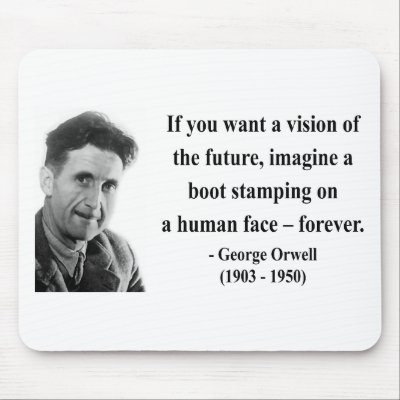
That is the totalitarian impulse which George Orwell described in 1984; the government outsources its surveillance of the public... to the public themselves. Whatever Dan Bloom might say to the contrary, I'm taking Pratt at his word. No doubt he thinks such professional snitches should be paid too were there to be a lack of volunteers (although I'm not sure there would be).

I should also note that Torch Pratt has prior form. Here he is in another (this time somewhat more confused) letter published in the Taipei Times on the first of this month calling for the actual deportation of members of the TDFA (or perhaps more likely, myself - simply for expressing opinions he doesn't like):
"Taiwan’s police need to get on this case like flies on ... honey and deport these trigger-happy idiots to a country where they might feel more at home, say Mexico or Somalia."
Can the Taipei Times actually sink any lower than this? We'll see...

Sunday, 27 November 2011

"Who, Whom?" Not "Rule Of Law"

"The notion of hate-crime undermines the ideal (and I think is intended to undermine the ideal) of equality under the law, to the great advantage of political entrepreneurs, who see nothing in a polity or an economy but spoils to be divided in their clientele's, and therefore in their own, favour."
The excellent Theodore Dalrymple, at the Social Affairs Unit, writing in response to a Guardian report on the horrific murder of one Stuart Walker in Scotland late last month.

The notion of "hate-crime" distinguishes crimes according to motive, in particular the hatred of a given demographic group - almost always a collective "minority" of some sort. In the case of Stuart Walker, it was supposed that his vicious murder was motivated by his homosexuality. As Dalrymple correctly points out in his piece, however, this is morally irrelevant: murder is murder, regardless of whether it was motivated by the victim's membership of demographic group A, B or C - at least that is, if we are to presuppose the sanity of a Liberal political paradigm in which individual rights are not punctuated according to demographics.

From the perspective afforded by the collectivist premises of those who advocate unlimited democratic government however, a victim's demographic profile is morally relevant since that data may have implications both for the "just" allocation of administrative resources and the pursuit or maintenance of political power. Here is the likely consequence of this tacit perspective both in the press and in the administrative organs of government per se: crimes will be ranked according to the demographic (i.e. political) importance of the victim.Victims who happen to be members of favoured demographic groups will receive greater press attention than those victims who do not have quite the same pretextual demographic "status". The administration of the police and judicary may or may not show favourtism - depending on the political import of the case.

The existence of this tacit line of thought in the press and the administrative organs of government alone is sufficient to refute their claims to that old "rule of law" canard. As long as Taiwanese society is dominated by a very poorly limited State, there can never be any "rule of law"; there can be only a more or less benign or more or less malignant application of Lenin's "Who, Whom?" principle.

And so it is this that must be borne in mind in reading about the case of a certain "Taiwan Teacher" (a U.S. citizen whom I have met previously, though I forget his real name) up in Hualien who was viciously assaulted by a gang of Taiwanese youths earlier this month. Perhaps the police will eventually catch them and the case will go to court. Perhaps not. Either way, I doubt the Taiwanese press will take an interest - why? Who cares? It has no great political implication for either the pan-green or pan-blue political establishment. If it were a gang of foreigners beating up a Taiwanese on the other hand, then that almost certainly would get the attention of the Taiwanese press.

This is why I made the point that, living here as foreigners, we have to be very careful and must not be so complacent with our own safety as to merely assume that we are protected either by the friendliness and good will of 99% of Taiwan's people, or Taiwan's supposed "rule of law".

Mr 1% is always out there, and either side of the green-blue political establishment has no great interest in what happens to a mere foreigner - unless he has political or, shall we say, "underground" connections.

March Of The Imbeciles

"Obama Democrats demagogue about the need to balance spending cuts with tax hikes. Republicans predictably respond that they were willing to compromise. When you are $15 trillion in debt, a debate over whether we should borrow another $6 trillion or another $5 trillion is not an exercise in compromise. It is an exercise in insanity."
Andrew McCarthy on why the Republicans deserve nothing but contempt.

No further comment necessary.

More, More, More...

Mark Steyn hits the right note yesterday:
"When it comes to spending and the size of government, only the Democrats are officially panting orgasmically, “More More More, How do you like it?”..."
The goal is unlimited, technocratic administration of society - total politicization. That is what the Left want; aside from a few outcast Marxists here and there, they have long since betrayed the Liberal paradigm of a free society in which government intervention is to be considered an evil, if perhaps a sometimes necessary evil. To them, government interventions are blessings from on high to be hoped and prayed for.

To the mainstream Left of today, there is no social problem that cannot be "solved" by the mere application of force paid for with other people's money. To leave such problems to the market or civil society is considered akin to leaving them to chance and chaos. People have to be forced into doing what the Left want - for their own good - and so all attempts to solve problems must be "coordinated" from above by government. They actually think they are doing good to people at the very moment they violate their rights.

And they simply can't get enough of doing this.

Friday, 25 November 2011

On Newt Gingrich

"Gingrich is a really smart guy and..."
Commenter "Okami" at Turton's place.

My opinion? Gingrich has not, to my knowledge, had a single serious and substantive word to say about monetary reform. Gingrich has shown no ambition beyond implementing mere managerial improvements to the Left's programs. Gingrich may be lauded as an "historian", or a "raconteur", or "a really smart guy" or whatever else in the right-wing press, but this will not change the fact that Gingrich does not grasp the ethical root of the problem.

Ron Paul has a vague idea, but Ron Paul is a ridiculous, tired old man who can barely mumble his way through a list of half-forgotten libertarian talking points.

Thursday, 24 November 2011

Taiwan's Perennial Problem

"The key, like with all traffic rules, is enforcement. If a rule is not enforced, few people will follow it, even if it is for their own good."
The Taipei Times staff editorial today, with the perennial call for greater police enforcement of traffic rules - for your own good.

Empirical question: since Taipei City has stricter traffic rule enforcement than anywhere else in Taiwan, does it also have fewer traffic accidents (note: not fatalities) per 100,000 people than Taiwan's other major cities?

It seems to me there are two reasons why driving in Taiwan is such a problem; the first is that the most dangerous habits people have are psychological and cannot be captured by law; the second is that these habits are culturally ingrained. I have made this case before in a letter last year which the Taipei Times published. You cannot force people to pay attention to the road and think about what they are doing by threatening them with fines and such. The notion that enforcement is "the key" presupposes that accidents are primarily caused by violation of traffic rules, whereas I strongly suspect that the chief cause of accidents is psychological negligence - which would also explain those accidents in which no rules were broken.

If I am right about that, then it follows that greater enforcement of traffic rules will only reduce accidents to the extent that such enforcement coincides with reduced pyschological negligence whilst driving, e.g. if drivers are having to stop and wait at red lights, then obviously they cannot be driving negligently whilst they are so stopped.

Traffic rule enforcement would thus, at best, be a flawed proxy for getting at the real problem of psychological negligence. If increasing such enforcement would be only slightly effective, yet very costly - as I suppose it would be - then surely it makes sense to approach the problem differently via popular education and civic pressure.

Of course, that would carry the implication that the Left must re-evaluate the technocratic Statist premises from which they reflexively jump to the conclusion that all social problems must be solved by spending more money to use greater force.

To abandon that premise is to no longer be part of the Statist Left.

***

There is a conversation that can be had between small government conservatives and small government classical liberals on the one hand, and the strict constitutionalists, minarchist libertarians and anarchist libertarians on the other hand. All of these people adhere to the basic premises of Liberalism, and that conversation is about how a free society should be constituted, whether there should be a State, and what its functions and limitations ought to be and on what principles they are to be based on, or whether the free market and civil society can produce an alternative institutional architecture based solely on voluntarist principles of cooperation.

Almost the entire mainstream Left cannot be part of that conversation because to them, freedom is either not a priority value anymore, or the assumption that only a behemoth centralized State can efficiently manage society is still treated as axiomatic - in spite of all its' obvious failings - and they therefore do not understand the point of the conversation.

T-34 Trainers


R.O.C. airforce trainee pilots in their T-34s on flight formation training over "Ah-Kung-tian" reservoir in Gangshan, Kaohsiung County yesterday.

AH-1W


At one point, whilst driving through some small factories which frustratingly obscured my view, an OH-58D "Kiowa" passed maybe sixty or seventy feet over my head, but by the time I fished the camera out, it was well off into the distance and I could only get a few poor shots. Just five minutes later though, on the road to Guanmiao, I stopped and waited and was rewarded with this - the AH-1W ("Cobra"), which, until the AH-64D Apache Longbows arrive, is the R.O.C. Army's attack helicopter.

TH-67A


Lots of R.O.C. Army helicopters out and about on training missions yesterday in the south-east of Tainan county. This is the basic pilot trainer, the TH-67, which is a military variant of the Bell 206.

Letter Against Edward Kung

Sirs,

It is surely a sign of the political weakness and vulnerability of the Left that they are now reduced to transparent chicanery. Edward Kung's letter (published Thursday November 24th) is a clear example of such obvious artifice; in arguing that the U.S. government must solve its debt problem by simply cutting military spending, he betrays not simply a personal ignorance as to the broader causes of that debt (i.e. the long term absence of both monetary and fiscal restraint), but the desperation of the Left to avoid re-examining the pragmatic and technocratic premises of their Statism.

Pace Kung's desperate turn to Ron Paul-esque isolationism, consider the facts: the largest proportion of Federal government spending in the U.S. - by far - goes into social programs. The largest of these are social security and the twin health programs of medicare and medicaid. Together with non-defense discretionary spending allocated by Congress, these areas of spending comprise nearly 60% of the Federal budget, compared to the 20% allocated for defense expenditure.

Moreover, we must remember that the current U.S. government has increased the debt in a mere three years by approximately the same amount (U.S.$4 trillion) as which the previous government increased it in eight years. That was not accomplished by any increase in military spending. That was accomplished by the application of quasi-Keynesian policies. Whose voices were the loudest in advocating these policies three years ago? Those of the Left.

It is the Left that is to blame for the U.S. debt problem, together with the inept Republican party which, as the current crop of abysmal Presidential candidates indicates, is shot through with the same pragmatic and technocratic operating premises which so animate the otherwise now rotten carcass of the Left. The debt problem is a consequence of the long term application of policies and programs originating on the Left (abetted by the fools on the Right), and this is why it is also the Left that is to blame for President Obama's failure to support Taiwan.

Why? They elected him.

Yours freely,
Michael Fagan.

(Sent: Thursday 24th November 2011. Unpublished by the Taipei Times).

Wednesday, 23 November 2011

Paul Rahe

"By behaving in the manner in which he behaved... he exposed, he pulled off the covers, of the tyrannical inclinations that lie at the heart of the administrative state - and people saw it. They saw it before their political leaders saw it."
That is Paul Rahe, of Hillsdale College and Ricochet on the historical significance of Barack Obama. And no, I do not think it is too early at all to pronounce on Obama's historical importance. That might just be the single best segment of interview I have ever seen on Peter Robinson's show.

I like Ricochet, particularly Claire Berlinski, but I will certainly have to read Paul Rahe's book.

Tuesday, 22 November 2011

Notice

Comments from the anonymous "reporter" of the Taipei Times will hereafter be deleted as a routine matter without exception.

Criticism and reasoned argument is one thing; single comment attacks with consistent and gratuitous use of foul language are another thing entirely.

Sunday, 20 November 2011

Gobi Desert Update

The Reg finally got hold of the Gobi desert story last Friday, but merely trotted out the Jonathan Hill line about satellite calibration.

I'm skeptical about that primarily because, as I said in my comment at J.M.Cole's place, the "grids" strike me as an unnecessarily complicated and uneconomical way to calibrate satellite cameras. Moreover, the scale on which they are built is much larger than comparable targets in the U.S. (which doesn't prove that they aren't for satellite calibration, but merely indicates that the Chinese satellites aren't necessarily very good).

If these "grids" really were for calibrating satellite cameras, then consider: calibration would have to be achieved by focusing the cameras serially on the differently sized spandrels between the "grid-lines" - yet these spandrels are all irregularly shaped. Would it not have been simpler and easier to simply use a proper grid-like pattern?

Here are the two Gobi desert "grids" which Anna Leach at the Reg supposes are Chinese satellite camera calibration targets.


And for comparison, here is an actual U.S. satellite camera calibration target:


They are totally different in both scale and design - with the U.S. site being a few hundred feet across and of multiple targets differentiated according to a regular scale, but the Chinese "grids" being over a mile across and consisting of multiple irregularly sized, but also irregularly shaped spandrels. Why?

Perhaps the editors at the Reg will reconsider this story; I am skeptical that those "grids" are used for the purpose of satellite camera calibration. What other possible functions they actually may be designed for, I don't know. Disinformation would be one guess.

The other thing that's worth noting, as I did in my first post, is the presence of airfields. The thing to do would be to try to estimate dates for the construction of the various airfields (and planned airfields) and weapons testing ranges. One of the commenters at the Reg article - one "Volker Hett" - pointed to a Spiegel article comparing an apparently painted airfield (not pictured in my previous blog post below) in the desert to the Ching Chuan Kang airbase in Taichung. This may just be coincedence, since after all, how many different designs can an airfield runway take? Nevertheless it would be interesting to know when the extant airfields were constructed, and when their adjacent structures were last bombed (and why only those adjacent structures and not the length of the runways themselves?).

Remember: the Presidential and Legislative elections will be held in January. When were the last weapons testing drills carried out in this area? The answer to that question might have political consequences.

Saturday, 19 November 2011

Through The Barbwire Of Inanities

"Society should be offended that men and women, many of whom were educated to the master’s or doctoral level by taxpayer money — either at home or abroad — continue to utter such inanities."
Indeed. Here is another such recent inanity: that we consider the DPP's "piggy bank" electoral gimmick as "Taiwan's version of the Jasmine Revolution".

History 101 for the politicians, current affairs 101 for the editorial staff of the Taipei Times.

***
I've said it before and I'll say it again: I want to see a show of hands as to who among Taiwan's U.S. expats voted for Barack Obama in the 2008 Presidential election. Aside from his authorization of Osama Bin Laden's assassination, President Obama's record has to be the worst of any U.S. President in living memory: his utterly craven political cynicism is such that Paul Kane's op-ed actually frightened people, lest President Obama act on its advice.

***
Because, as I pointed out here on Wednesday, the TPP is not a free-trade agreement. It is a political agreement on how member states shall govern trade between peoples subject to their legal jurisdiction. Moreover, even when the question is considered in conventional terms, the obvious answer is mundane: the greater the number of member states present at the negotiations, the more difficult and time-consuming it is to reach agreements. The TPP agreement has only ten member states, yet the Doha trade talks took place under the auspices of the WTO with one hundred and fifty three members, including the world's largest member states by population (i.e. China, India and Brazil). That the U.S. government was unwilling to eliminate farm subsidies - as requested by many of the smaller member states, and also the government of India - was one reason why the talks collapsed.
"The agreement would also have provisions for intellectual-property protection and what are dubbed the social and environmental issues. In short, the TPP’s core agenda will offer the region a Doha Round-type agreement that includes the social and environmental agenda that developing economies have been resisting within the WTO."
This is a point which deserves more emphasis; the objective of the TPP agreement is not to secure "free-trade", but rather to harmonize the terms under which the ten member states restrict and regulate trade and subsidiary matters. With the TPP agreement in place, not only can developing economies like China's be excluded from the new Pacific trade bloc, but it becomes politically more difficult for any government within this trade bloc to disentangle itself from prior legislation made under that agreement, since such legislation will have been one aspect of a the multi-lateral agreement linked to long-term tarriff reduction.
"While the economics of the TPP is important, the strategic component is even more so. This is the second leg of the US’ new “Pacific offensive,” aimed at offering nations in the region an alternative to excessive and rapidly growing dependence on a rising China."
That may be the motive behind the recent entry of the U.S. into the TPP agreement, but whether it will come to have this effect or not (or indeed, other unintended effects) is another question. The premise of this strategy is the continuation of the much hyped "rise of China". Yet the PRC is already suffering from its own self-generated problems which may yet bring it to the verge of collapse before the decade is out. For the vast majority of the Chinese people, a collapse of the Communist State would mix liberation with catastrophe. The TPP agreement may or may not help to bring about eventual collapse, but when that collapse does occur, what do we think will happen next - a new and magically democratic China rises to join the TPP under the same terms?

Rather than TPP member states trying to protect "their" people through a trade-governance agreement propagandized as a "free-trade" agreement, the governments of the Pacific area would do better to agree on a depoliticization agreement to eliminate all legislation that prohibits competition, and to eliminate or radically reduce taxes, regulations and subsidies. That would be a real free-trade agreement.

***

Friday, 18 November 2011

On The Paul Kane NYT Op-Ed

Following last week's publication in the New York Times of a guest op-ed by a certain Paul Kane, there has been a flurry of enraged responses - particularly from supporters of Taiwan independence on the Left. In Taiwan itself, the Pragmatist seems to have been the first to react with follow up responses from other bloggers in Taiwan and, naturally, the people at the Taipei Times: both Washington correspondent William Lowther and deputy news editor J.M. Cole had words to say about it. Even Kane himself later tried to distance himself from his own writing in an apology piece for Foreign Policy by claiming his article was intended as "Swiftian satire". Yet at a time when the sitting U.S. President can spend almost as much money on "stimulus" in a mere three years as the last President did on wars over a decade... readers can surely be forgiven for a lack of distinguishing humour.

Although I too thought Kane's piece was bad, I nevertheless find one aspect of the affair perversely amusing.

Kane's piece called for the Obama administration to close a deal with the PRC whereby the latter would agree to a debt-forgiveness plan to the tune of U.S.$1.14 trillion and the former would renege on long-standing U.S. commitments either to defend Taiwan, or to supply Taiwan with defensive articles.

Of course, this is an utterly crass, amoral and naive utilitarian calculation. As noted above, Kane himself, in his Foreign Policy response, claimed that he had written it sardonically. This may or may not be the case; either way, it certainly made quite a few heads "explode" over here in Taiwan.

Yet what I find perversely amusing is that Kane's argument, once you subtract its' obvious crassness and apparent naivity, arises from the same collectivist-utilitarian premises that much of the Left routinely operates on - i.e. that the State must always act to protect and advance the "common good", even if it means deliberately violating the rights of individual subjects. There is no difference in the principles involved between an argument for legalized land theft in order to construct say, a factory that may benefit the wider economy, and the selling out of an entire island in order to acquire a write-off of public debt. The only differences between the two arguments are the empirical accounting of collective benefits and assessment of strategic outcomes.

Thus, many of the criticisms put to Kane have centered on just such points, e.g. the benefit to the U.S. of a $1.14 trillion write-off would be relatively small; the "naivity" of his view of PRC ambitions. Such criticisms are all valid, but they do not get to the root of the matter - they are not actually damning criticisms at all, but mere fannying about with vague calculations of interest.

Memo to the Left: Kane's is the kind of absurd conclusion to which the logic of your amoral, majoritarian Pragmatism points. Of course, it would be an irony too far to suggest that this was the real reason why Kane had his article published in the New York Times (!), so perhaps he really was just being "Swiftian"?

Thursday, 17 November 2011

Strange Objects In Gobi Desert

The Chinese have been busy in the Gobi Desert it seems. Wired has the best coverage of the story I've seen so far, although I got it from J.M. Cole and it was originally dropped to someone at the Telegraph (so apparently that place has not quite been taken over by the "women's interests" section yet). Apparently, people have been using Google Earth/Maps to observe what's been going on in this region of the Gobi since 2004. Here are some of the snaps I took just in the last half hour or so...


These two images above have been drawing perhaps the most attention. The first* shows one square and one rectangular configuration - both of vast proportions - seemingly carved into the desert. The second shows a neatly cicular, target-like arrangement of what seem to be shipping containers and other objects with three aircraft surrounding the centre of the arrangement. Each of the three aircraft appear to be early Mig fighters (e.g. Mig 21s) since they all have the same swept-back wing design and truncated nose - although it is difficult to be sure from the resolution.


This next image, taken at greater distance, shows three airfield-like structures. Two of them are several kilometers in length. The one to the left and the one in the centre both have the same basic, dual "runway" design whereas the smaller one to the right is a short single strip. The one to the left appears to have fallen into disuse many, many years ago; the one in the centre appears to be a replacement for it since it follows the same design and is a shiny, metallic hue. The smaller one to the right also has the same shiny metallic hue, but appears to be partially damaged by mudslides.

The image also shows some smaller, square-like structures adjacent to the top right of each of the two larger "airfields". To the top right of the older, disused "airfield" there is this bright blue square covered in what seem to be bomb craters...


To the top right of the newer "airfield" are what appears to be an approximately circular arrangement of seven, partially destroyed, hangar-like buildings, the largest three of which feature very bright blue roofing materials.


Adjacent to the central "airfield" there is also what looks something like a partially destroyed barracks...


There are several other objects visible on the google maps satellite overview of this area including what seems to be an electricity transformer station in addition to some vast, bright metallic blue structure and other interesting things. I may add more to this sometime tommorow.

Later...

Here are some of the other structures within the vicinity of those mentioned earlier. First, the large sky-blue coloured structure - perhaps some sort of vast artificial reservoir or other water containment or treatment system?


The white blocks to the right of this next image below appear to be regular and square shaped, with light reflecting from some of them which suggests they could be solar panels. As to the green and white rectangular shaped objects to the left of the image - I have no idea.


*[Later...] Speculation as to the purpose of the rectangular, "street-like" arrangements seems to focus either on their possible function for the calibration of satellite cameras, or as some sort of mock-up of a U.S. or other city.

With regard to the first conjecture, I am not in a position to say anything knowledgable but it does seem that the structure is a rather complicated and uneconomic way of achieving that aim - if the need is for a large site of known dimensions with sufficient visual contrast, then why not, for instance, simply focus on beaches? At the coast there is a naturally stark visual contrast between the sand and the sea (or the sand and nearby urban structures such as roads). If it is objected that erosion of the sand would make the beach an unreliable site, then why couldn't they simply paint the artificial wavebreakers? The conjecture may be correct that these things are for satellite camera calibration, but I'm yet to be convinced of this.

In respect of the second conjecture, the unspoken assumption that the rectangular "street-like" arrangement is to model radiation fallout in a city-centre strikes me as so unlikely as to be absurd; if the PLA were to launch a nuclear attack on a city (e.g. Taipei), then the pattern of nuclear fallout on a mere several mile scale is the last thing they'd worry about. If that tacit assumption is discarded, then it is difficult to imagine what purpose the PLA could achieve by modelling a city road map out in the desert. Taken together then, I think this conjecture has to be relegated to an implausible status.

Wednesday, 16 November 2011

The "TPP" Is NOT A "Free-Trade" Agreement

First quote:
"US President Barack Obama announced on Saturday the framework for a vast free-trade agreement spanning the Pacific as he sought a new era of US leadership in a fast-growing region."
This is from an AFP piece published in the Taipei Times earlier this week on Monday. What's wrong with it is the now routine appellation of "free-trade agreement" to what is actually an agreement between ten governments* in the Pacific region to harmonize the terms of government intervention viz capital controls, labour laws, environmental regulations and other matters.

Second quote:
"The TPP started out in 2005 as a free-trade agreement with four signatories — Chile, New Zealand, Brunei and Singapore — with the US, Australia, Malaysia, Vietnam and Peru joining later."
This is from today's Taipei Times editorial, which is the editorial written by a member of the editorial staff, rather than an imported piece from one of the main press agencies. Thus somebody at the Taipei Times is directly responsible for it. Again, what's wrong with this is the routine transmogrification of the adjective "free" to describe something which is not free.

To some people, it may seem like a trivial point to criticize the editors of a newspaper for one ill-chosen word. However, there are three serious implications here.

The first is that it directs attention toward a narrowly framed objective of the agreement (trade "liberalization" by means of tarriff reduction), rather than the procedural actions that will be taken in the name of that agreement. Yet it is the procedural actions to be taken that warrant critical attention, not the mere objective. The reason this is important is that because the TPP agreement provides for the reduction of tarriffs through an expanded process of multi-lateral negotitation and agreement between member states, the process of tariff reduction and other aspects of trade liberalization will likely get bogged down by political calibration (as with similar WTO-sponsored trade talks). It would be much better for the cause of freedom to see member states unilaterally dismantle barriers to trade to set an example for others to follow**.

The second point is that this TPP agreement is not merely concerned with the multi-lateral reduction of tarriffs; the broader "trade liberalization" objective encompasses an agreement to harmonize the purposes and design of government intervention in all member States. That is the behaviour of a cartel; rather than member states competing against one another to attract both foreign investment and immigration by imposing different investment, labour and environmental restrictions and regulations, both immigrants and investors will now have less of a basis on which to choose between member states rather than more of a basis on which to choose. Thus, to describe this agreement as a "free-trade" agreement is a travesty. It is an agreement toward the cartelization of governance.

The third point follows from the first two in that calling this agreement a "free trade" agreement is a linguistic bug which will tend to retard the quality of public debate. It is quite sufficient for the purposes of journalistic accuracy to refer to this type of agreement as simply an "agreement on governing trade", or, should a greater economy of words be required, a "trade governance" agreement. Inserting the superlative "free" into the description can only serve the purposes of propaganda, since it is not a "free-trade" agreement by any honest use of the concept.

Perhaps somebody else should write to the Taipei Times to correct them on this point; anything I would write to them would be both feared and loathed.

*Brunei, Chile, Singapore, Australia, New Zealand, Malaysia, Peru, Japan, Vietnam and the United States.

**I would argue this point from ethical principle. Whether unilateral dismantling of trade barriers would be "better" on consequentialist grounds is an open question; if an honest attempt to answer that question is to be made, it will have to go beyond the mere confirmation bias of establishment Marxists like Ha Joon Chang.

"Capitalism" As Anti-Concept


Government "favouritism" toward business is a political contingency, i.e. a given business may or may not be treated "favourably" or "unfavourably" relative to some other individual or set of individuals (or another business) depending on whether there are operant political interests involved and what these political interests are.

That criticism aside, I think Long makes a reasonable case for insisting on a distinction between "capitalism" and "free-market".

However, it is important to remember that this distinction will be lost on two kinds of people: those whose minds tend to naturally fixate upon a narrow conception of consequences and those who are simply opposed to the basic principles of a free society to begin with.

Reform, Self-Critique & Reinvention

"In one of the most amazing transformations in the history of civilization, a tiny East Coast community of predominantly white European Christian settlers developed a system whose natural logic of reform, self-critique, and reinvention over two centuries became the present melting pot of whites, blacks, Hispanics, Asians, Christians, Jews, Muslims, Buddhists, agnostics, and atheists."
Victor Davis Hanson.

The Western tendency toward self-critique is what sets us apart from other people, both culturally and psychologically. It is our one characteristic that Chinese people have most to fear from, and yet the most to gain from.

Saturday, 12 November 2011

On Firearms Ownership

I was recently involved in a slightly rough-and-tumble firearms debate here, chiefly with the British blogger FOARP* (the "scarlet conservative"). Since my opponents seem to have "bowed out" of that debate in their own graceless fashion, I thought I'd give a brief precis of why I am right and the firearms prohibition advocates are wrong:

The right to own firearms is no different from the right to own any other type of property.

Against this, firearms prohibition advocates will argue that private firearms ownership poses a significant exernality risk to others in society, and that therefore, government should strictly prohibit the private ownership of firearms. Notice that this counter-argument rests on two claims, the first of which is a factual claim and the second one is a contingent ethical imperative. I will first refute the factual claim, and then I will refute the imperative attached to it.

The Facts

The factual claim, that private firearms ownership poses a significant exernality risk to others, may be made on the back of three seperate sub-claims:
  • 1) Privately owned guns are more likely to be used in committing violent crimes than they are in self-defense.
This claim requires the abstraction of aggregate statistics from context; it ignores the fact that many gun-owners live in areas with relatively low crime (whether that low crime is consequent to the private ownership of firearms is another question) so of course these gun-owners are less likely to use their guns in self-defence than say, someone living in places where the crime rate is relatively high.
  • 2) Homicides tend to be committed by people known personally to the victim, such as friends, family or spouses.
This sub-claim is used to argue that the introduction of private firearms ownership would likely increase the homicide rate, since firearms make it physically easier to kill. This may or may not be true, since it depends on other things, particularly the sort of people who acquire guns; good people don't use firearms in situations other than self-defence or training, bad people use them to commit crimes - either of passion or of acquisition. Yet preventing bad people from acquiring firearms is not going to prevent them from committing homicides.
  • 3) Homicides involving the use of firearms are as likely to be committed by any demographic subset of the population and that there is thus no "ideal" gun-owning subset of the population.
This claim is simply not true (which means it is either made in error, or it is a lie). The proportion of the U.S. population estimated as owning firearms is somewhere between 40% and 50%, yet the proportion of murder/manslaughter offenders using firearms is somewhere around 1% of the population. Thus most people who own firearms in the U.S. do not use them to commit murder/manslaughter. QED.

The Imperative


The imperative claimed by firearms prohibition advocates is that since (or so they wrongly suppose) private firearms ownership poses significant externality-risks to other people, government must therefore strictly prohibit or otherwise strictly control the private ownership of firearms.

The principle at work in this claim is unqualified majoritarianism: if a majority deems private firearms ownership "too" dangerous, then the government should prohibit it. The underlying premise is crude, amoral utilitarianism, i.e. that government should act for the "greater good"** on no other definition than subjective majoritarian preference. Yet this can cut both ways; if a majority regard private firearms ownership as fine, then it "ought" to be legalized. Thus, this isn't even an ethical argument against private firearms ownership per se, but rather an argument for the authority of government, and nothing more.

As an argument for the authority of government, however, it is simply amoral, majoritarian tyranny: the government ought to do whatever the majoritarian mob says it ought to do (and perhaps after they have been whipped into a fervour by some demagogue). It does not even include the usual caveats as to the rights of individuals (or, in bullshit Lefty speak "minority groups").

So far as I am aware, firearms prohibition advocates have no other specifically ethical argument for State prohibition of private firearms ownership; correct me if I am wrong.

***

All that being said however, I can certainly think of a subtler, more persuasive argument for firearms prohibition - which is that responsible and peaceful firearms ownership can only occur in places with the necessary socio-cultural prerequisites. These prerequisites would include widespread respect for the rights of the individual, including the right of private property, and the principles of free exchange, free speech and free association. Where these socio-cultural necessities are lacking or suspect, it is easier to doubt the consequentialist benefits for society of private firearms ownership. This argument is especially salient to me here in Taiwan since the broader culture elevates the importance of "face" to what I take to be ridiculous extremes - I can quite easily imagine a couple of locals shooting each other over competing claims to a girl or some other, far more trivial, loss-of-face-issue (e.g. "He called me a 白痴!").

There are two things to say about this. The first is that it is not of itself a trump argument since it is still based on the collectivist "greater good" premise which would still deny to individuals the right of purchasing the most effective means to defend themselves. As an objection however, it still leaves me hungry. The second is more interesting - it is the question of whether we can identify what other actions ought to be taken in conjunction with the legalization of private firearms ownership in order to reduce the risk of any possible increase in violent crime. The low-hanging answers here are obviously things like training, ethics and licensing, but I doubt these are sufficient to overturn many decades of deeply entrenched cultural habit. A training program with a very strict ethical aspect may go some way to moderating the influence of culture, but I'm not sure this is something I'd want to bet on. Reaching somewhat higher up there are the libertarian arguments about diminishing or indeed eliminating the influence of government so as to allow a direct, market-mediated relationship between people and the local police departments that purport to serve them. By allowing the market to restructure the incentives under which police operate - focusing more on violent crime and less on minor traffic violations for instance - it may be possible to more forcefully augment the moderating effect that strict training and licensing would have on the cultural difficulties in resolving personal conflicts without resort to violence.

*I have a comment at his place on this post, which is either awaiting moderation, or which he has rejected. "Scarlet conservative", is, I think, an apt description of him.

**By "the greater good" I mean unqualified majoritarian preference, which is distinct from "the common good" and also "public goods". A "common good" is a good in which it is supposed that everybody in society places some value; typical examples include innoculation against contagious diseases and defence against invasion by foreign armies. A "public good" is one which is made available to everybody in society on a non-excludable basis; radio programs are a standard example since they can be picked up by anybody with a radio receiver. The use of the "common good" and "public good" concepts is common among free-market advocates and libertarians since they are a significant theoretical issue. The use of "greater good" arguments is common in both the Statist wings of the Left and the Right in order to justify social engineering projects such as State education, or the State prohibition of prostitution and so forth.

"Fast & Furious"

"By the time Cornyn was done drawing this stark contrast between Wide Receiver and Fast & Furious, Holder was reduced to conceding, “I’m not trying to equate the two.” That is big of him given that the two cannot be equated. But the attorney general seemed fine with the effort to equate them — to make them one and the same — when it was Schumer asking the questions. Expect the effort to continue. “Bush did it” may be a tired defense, and in this instance a preposterous one, but it’s the one the Democratic base loves to hear."
Andrew McCarthy is keeping an eye on the U.S. Senate hearings on the Gunwalker scandal in which it seems that members of the Obama administration - possibly including Attorney General Eric Holder himself - are guilty of abetting criminal activity by Mexican drug cartels.

When the U.S. government smuggles firearms into the hands of foreign criminals seemingly in order to justify further gun control measures in the U.S., it only brings the amoral and utterly cynical nature of the current government into sharp relief.

For all the gutter-class conspiracy theories out there "occupying" the minds of morons in places like Zucotti Park, here is a Senate hearing on what seems to have been a real government conspiracy - which is precisely why many people on the Left will try to ignore it.

When Are "Savings" Not Savings?

"Have you been following this so-called Supercommittee? They’re the new superhero group of Superfriends from the Supercongress who are going to save America from plummeting over the cliff and into the multi-trillion-dollar abyss. There’s Spender Woman (Patty Murray), Incumbent Boy (Max Baucus), Kept Man (John Kerry), and many other warriors...

...It turns out that a committee created to reduce the deficit is instead going to increase it..."

Mark Steyn measures the distant enormity of the Left's elected "intelligentsia" between his thumb and forefinger. For the answer to my question, read the whole thing.

What a spectacular evil - to be calling for increased government spending just as the country is staring bankruptcy in the face, and to be doing so under the guise of "reducing the deficit"! What a show.

The Left: from their elbows-for-brains "occupiers" in Zucotti Park, to their media operatives, their academics, all the way up to the elected officials of the Democratic party - the entire spectrum of the Left in the U.S. and the Western world today represents both the betrayal of the Enlightenment and the continual kampf of its' counter-force, the Endarkenment.

Always remember the Fabians and their stained-window with its explicit portrayal of their endorsement of force (hammers) and deception (wolf in sheep's clothing):
"Remould it nearer the heart's desire!"
These people - those of them who are not merely imbeciles - are possessed of amoral collectivist premises, and their institutional power must be drained away.

Picky (挑剔) / Little Red (小紅)


My Taiwanese friends call her 小紅 (Shao Hong) - which means "little red", which is nonsensical because she is neither "little" (she weighs almost sixty pounds) nor "red" (she's black with streaks of light brown). The reason they call her 小紅 is that three years ago she used to have a red collar.

I began calling her "Picky" shortly after she first showed up in the park because, after she overcame her initial nervousness around people, she was still very fussy about food - sometimes she would eat what was offered her, but often she would not even though she clearly must have been hungry (you could see her ribs). To this day, no matter how much I try to fatten her up, she is still very lithe.

This dog is tough. She's about five or six years old I think, extremely athletic, agile and physcially confident and has almost always bossed the other dogs (though not without being checked by me). She has survived three years in that park with only occassional medical help from me and my Taiwanese friends (although food has been regular). In the last couple of times we tried to help her, I have had to carry her around on my shoulder to take her for an X-ray (we had to use a dart to render her unconscious), and I've been bitten for trying to move her leg to help the vet give her a shot. She cannot be taken willingly to the vet's, and she never leaves the park (which is good, because that reduces the chances she'll be run over on the roads).

She does, however, like to bark at people riding bicycles or scooters through the park after dark. This is something of a problem, not because she will bite anyone - I doubt it - but because many Taiwanese people are afraid of dogs and because the younger dogs sometimes imitate her. I can check them when this happens, but I have to anticipate it happening and raise my voice before either Picky or the other dogs get carried away.

She is also a stickler for attention. She will often approach me orthogonally when I'm reading the newspaper or playing with another dog and force her nose under my elbow, or under the newspaper or try to stand in front of me so that I will stroke her back. I can only get on with what I'm doing if I pointedly ignore her for a few moments.

All the same, I cannot imagine what life at the park would be like without Picky.

Friday, 11 November 2011

Kinkaseki, Keelung

大保 (Da Bao)


The runt of the litter - notice the chew marks on his right ear. He has also taken sick and has been staying at the vet's for two days now.

Thursday, 10 November 2011

小白 (Shiao Bai)


He's been back at the park for a few days now, and I'm there three times a day to look after them. Hopefully, with all the pork and biscuits I bring with me, he'll put on a five or six pounds before winter sets in.

Tuesday, 8 November 2011

Monday, 7 November 2011

November


I was going to post a picture of Shiao Bai now that he is better and back at the park, but I don't have a good one yet. I'll try and take a good one tommorow or Tuesday. Instead, this is a picture of his brother taken on Sunday morning (the 6th).

Sunday, 6 November 2011

我努力可是需要努力更多

"我感到很遺憾,因為對於這些人來說,他們可能會覺得台灣是非常糟糕且不值得拜訪的國家。我喜歡你的部落格,因為你是為自己而寫,就算你批評台灣,但你也提出了很好的建議,並且真心希望台灣可以更好。"
致謝您"台灣人". 很的置評讓我很自豪.

Approximate translation...
"I like your blog because you write/be yourself and even though you criticize Taiwan, you have yet made very good constructive suggestions in a sincere desire for Taiwan to improve."
Thank you "Taiwan Person". Your comment is very gratifying.