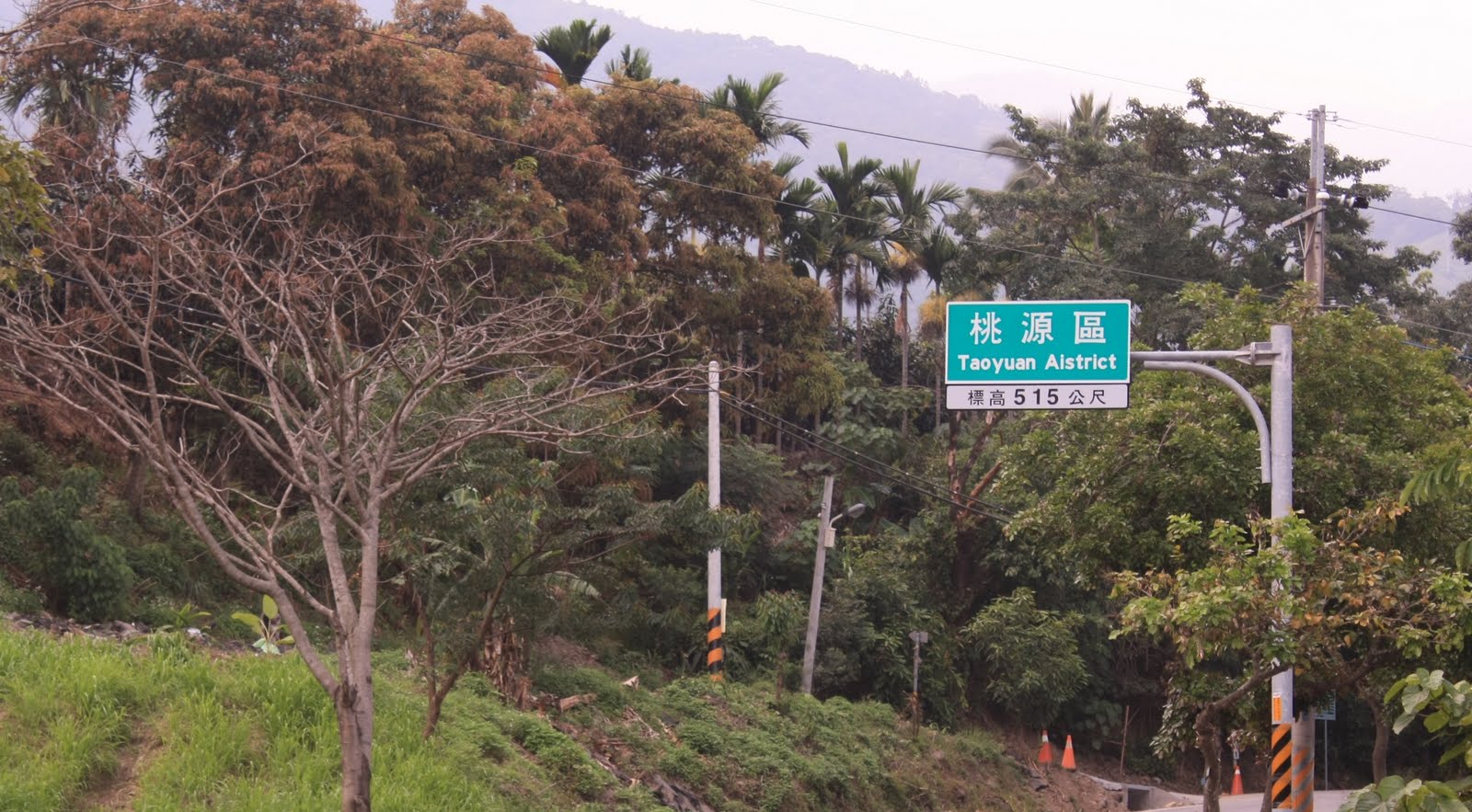
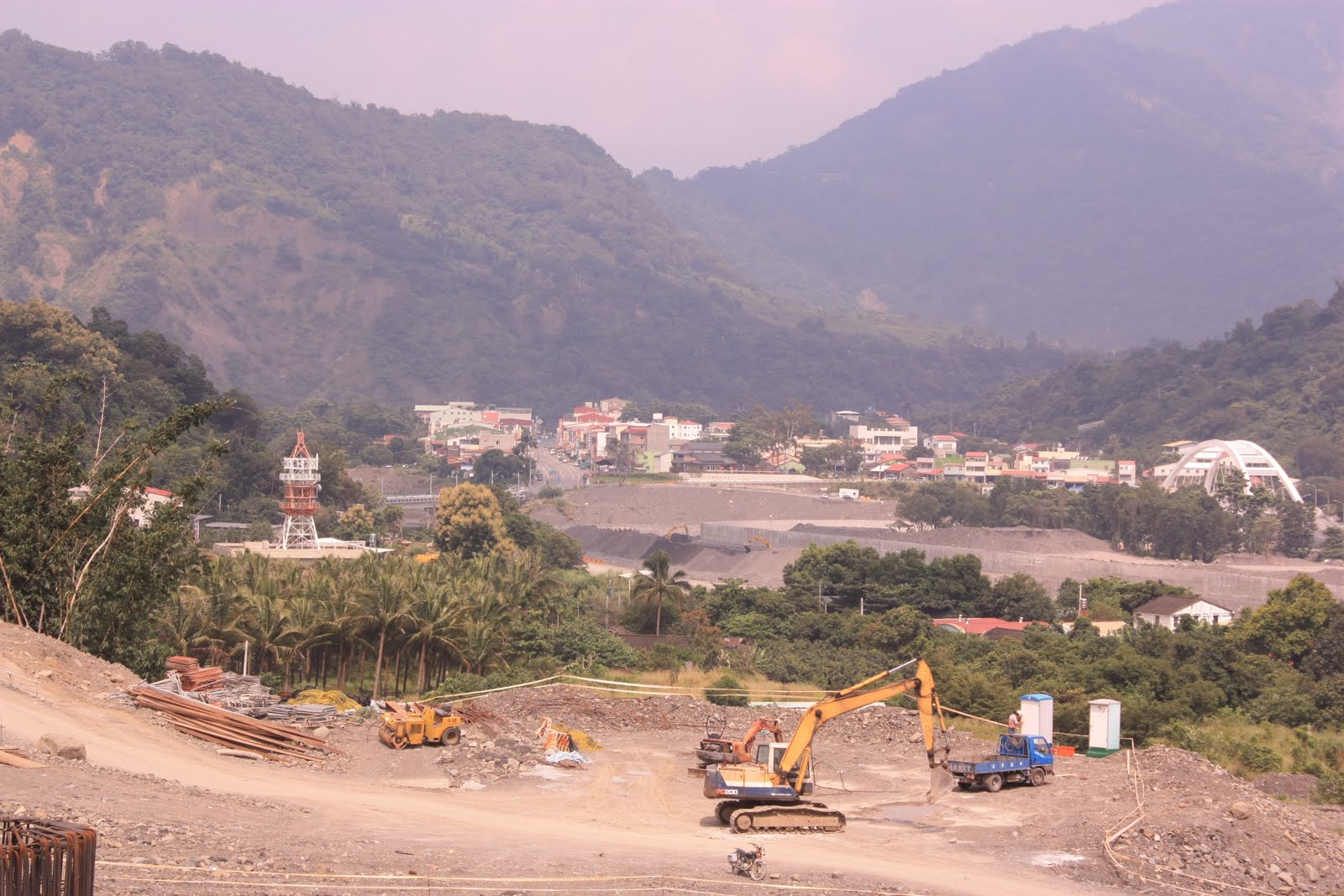
I took a day off on Wednesday to drive east through Tainan County, down and up again into the further reaches of Kaohsiung County. What I had in mind was to find the 少年溪 watefall I had spied on a trip out to the same area back in June, and to see how far I could get along route 20 (e.g. to the border with Taitung County) before having to turn back. After leaving the Nanhua District (南化區) of Tainan County on route 20, I passed through three Kaohsiung districts - Jiaxian (甲仙鄉), Liugui (六龜鄉) and Taoyuan (桃源區)...


In the signs above, notice that the first one says Kaohsiung "City" rather than Kaohsiung "County", which is a consequence of the recent administrative restructuring. I didn't like the decision itself, but whatever its' demerits may have been it is undeniably absurd to be way out in the sticks and yet confronted with a sign telling me I am in the city. The other thing of note there is the misspelling of "District" as "Aistrict" in the Taoyuan sign. That sign actually appears long after route 20 has made its way into Taoyuan District, and indeed, after it has passed through the village of Taoyuan itself. Road signs in Taiwan are often a bit weird.

Here is a map of Kaohsiung County strung up at the police station in Taoyuan village itself. Taoyuan district is the big one at the top, with Liugui and Jiaxian the slightly yellow and pinkish districts to the immediate south-west of Taoyuan. Before getting out into Kaohsiung however, I stopped to check the water level at Nanhua Reservoir...

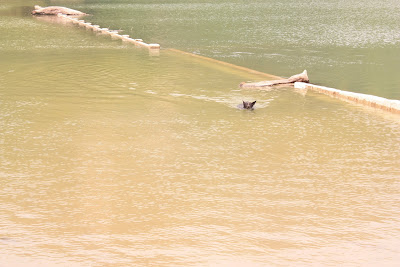
This bridge, from which people had been fishing
last time I was here at the end of June, was now completely submerged. So naturally, my four-legged friend decided to check it out...




Driving up around the reservoir, I stopped to get a long-lens shot of the damn itself. Although the high-water mark hasn't quite been reached, the water is only a few feet from disappearing over the
spill-over lip - the reservoir is full.

The drive down to Jiaxian is relatively short - about 15 minutes - and usually I would stop for lunch here, but as I wasn't hungry and mindful of the distance I decided to keep going and stop to eat later in Baoli (寶來).

Up in the mountains, perhaps 10 minutes outside of Jiaxian, there is a section of route 20 which seems to be constantly under repair every year. It was no different this time...


As the road surface is little more than a dirt track, it is nightmare to cross in the dark when it is raining (which was something I would have on my mind during the return leg later). In the bright sunshine though, it's not a big deal.

Water seeping through rock fissures by the side of the road.

The sign in the top left here is the Liugui district sign, which greets you on your exit from the constantly-dodgy section of route 20. The roads are mostly superb after this point...

... until you get on to the approach to Baoli that is...


I stopped for lunch here: in all the times I've been through Baoli I've never stopped for the hot springs. Even though I've lived in Kaohsiung and Tainan for years, the only hot springs I've ever been in were in Taitung
and Taipei (memory fart: I remember being with the girlfriend and
wanting to go into a hot springs in Taipei, but for one reason or another we didn't). It's the mountains and the drive itself I come for...


Broken bridge about ten minutes outside of Baoli.

Every so often, route 20 allows you distant views of the small waterfalls down on the other side of the river...


Taoyuan village itself.

Looking back the way I had just came at the entry to Taoyuan village (note the characters for "Taoyuan" on the rock to the left of that image).

Cricket on the village green? No. I'm on the other side of the planet, so it's baseball practice for the aborigine kids.

The sign in this image above points rightwards for Shaonianxi Waterfall, however, the suspension bridge which used to connect this little village to the waterfall has long since been washed away (very likely by Typhoon Morakot in 2009).

Clicking on this image, you should be able to make out (toward the bottom right of the image) the partial remaining structure belonging to what was once the suspension bridge. The waterfall itself isn't visible in that image, but it is just off out of shot at the top right. Of course with the haze being as bad as it was, many of these pictures are a bit lousy.

For this image, I strolled around behind one of the village buildings to try and get a direct shot of the waterfall from a distance as I was a little worried that I may have some problems later in trying to get close to it. It is dead on in the middle of the image and barely visible as a tiny streak of silver.

Far clearer in this shot with the 250.

Anyway, so off I went until I came once again to the
Big Cliff which so enthralled me
last time I was here. On this occassion however, the road was closed to allow earth movers to clear up the mess of a recent, minor landslide.


When I arrived it was just after 3pm, which meant I would have to wait until 3.50pm to get through. Not likely. While I was there, I fell into conversation with an Aborigine lad. He told me two very interesting things. First, when I mentioned
the lake on the other side of the cliff and wanting to take a break there with the dog again, he told me the lake was gone! Of course I wasn't going to hang around for nearly an hour just to check whether this was true, but when I mentioned that I was hoping to cross over to the lake so as to access the mountain road on the other side of the river to take me back towards the Shaoniansi waterfall, he mentioned a little road going out there from Taoyuan village itself. Instantly persuaded, I thanked him and set off to drive back across the broken roads to Taoyuan village and find the little road he was on about. I did indeed find it, and it was indeed "little" but it reached right up to the edge of the cliff just about visible (despite the excess light) to the mid-left of
this picture above. Here are the views down from about 200-300 ft up on the mountainside...

This is the little village past Taoyuan and just before the
Big Cliff - where I snapped that sign for the former suspension bridge to cross toward Shaonianxi waterfall. Just before arriving at the precipice, I had to turn down a little farmer's road from another little village above Taoyuan itself. A dog came trotting out all snarls when he saw Tinkerbell on the bike - realizing I'd got myself into a cul-de-sac and that I should take the little farmer's road down to where the precipice would logically be, I made to turn the bike around but he was already onto us, so I gave him a kick in the chops with a heavily accented
"f*ck off" - which did the trick.

The views would have been spectacular without the awful humidity. In this image, the aforementioned
Big Cliff, is just beyond the last clear green hill on the right. You can also make out where the lake would be, but the haze means there's nothing but a grey, indiscernable fuzz. Of course the remarkable thing that this image shows is just how swollen the river would have been during Typhoon Morakot in 2009. It's no more than a comparative trickle now.

This mountain road is very bumpy, very steep and very narrow on its winding approach down toward the farms below Shaonianxi - you wouldn't want to try it on anything other than two wheels.

This is the sign on arrival.

There is a clear stream running down from the waterfall and passing under this long-ago broken bridge. Notice the ladder propped up alongside it on the left - there's nothing up there, since the road is severed on the other side too, so it's not obvious what it's there for (I didn't bother climbing it, but looking back now maybe I should have...).

This was the spot, there was nowhere left to drive to, but I was still some distance away from the waterfall itself. I'd have to treck my way upstream, which only gave me pause for half a second to register my hunger and the fact that my bottle of
alcoholic cough medicine was nearly empty by this point. Whatever.

It was a good twenty to thirty minute hike as the stream had to be forded again and again and again and I was always mindful of my dog so as not to allow her to stray too close to any of the minor waterfalls as I reckoned the current to be just about strong enough to take her down.

There was also an eerie noise, which I quickly realized was the sound of pressurized water escaping at irregular intervals from holes in the rubber and polymer pipes stringing their way overhead from the waterfall to feed the farm down behind me. There was only that and the sound of the stream and the odd bird or two. Girlfriend wouldn't have stood for it, unless perhaps she was part of a group. I like this sort of thing though.

Upon reaching the summit, I was disappointed by the size of the pool - so much so that I didn't bother going down to check it out. Instead I snapped away at the fall itself, transfixed. The fall looks about 80 odd feet high (about 30m), and the water hits the pool at such a speed to put you in mind of the rippling airflow out the back of a jet engine... good stuff.


I didn't stay for too long as it was now 5pm (I had left Tainan City at about 10.30am), the light was beginning to fail and the sky was clouding over and threatening rain. And I was hungry. The thing to do now is to make a return trip, but to leave Tainan at a ridiculous hour like 3am in order to arrive at Shaonianxi just after the crack of dawn - I suspect that, with the sun in the east, the waterfall might at some point get fantastic sunlight streaming down upon it.

Until next
time...